
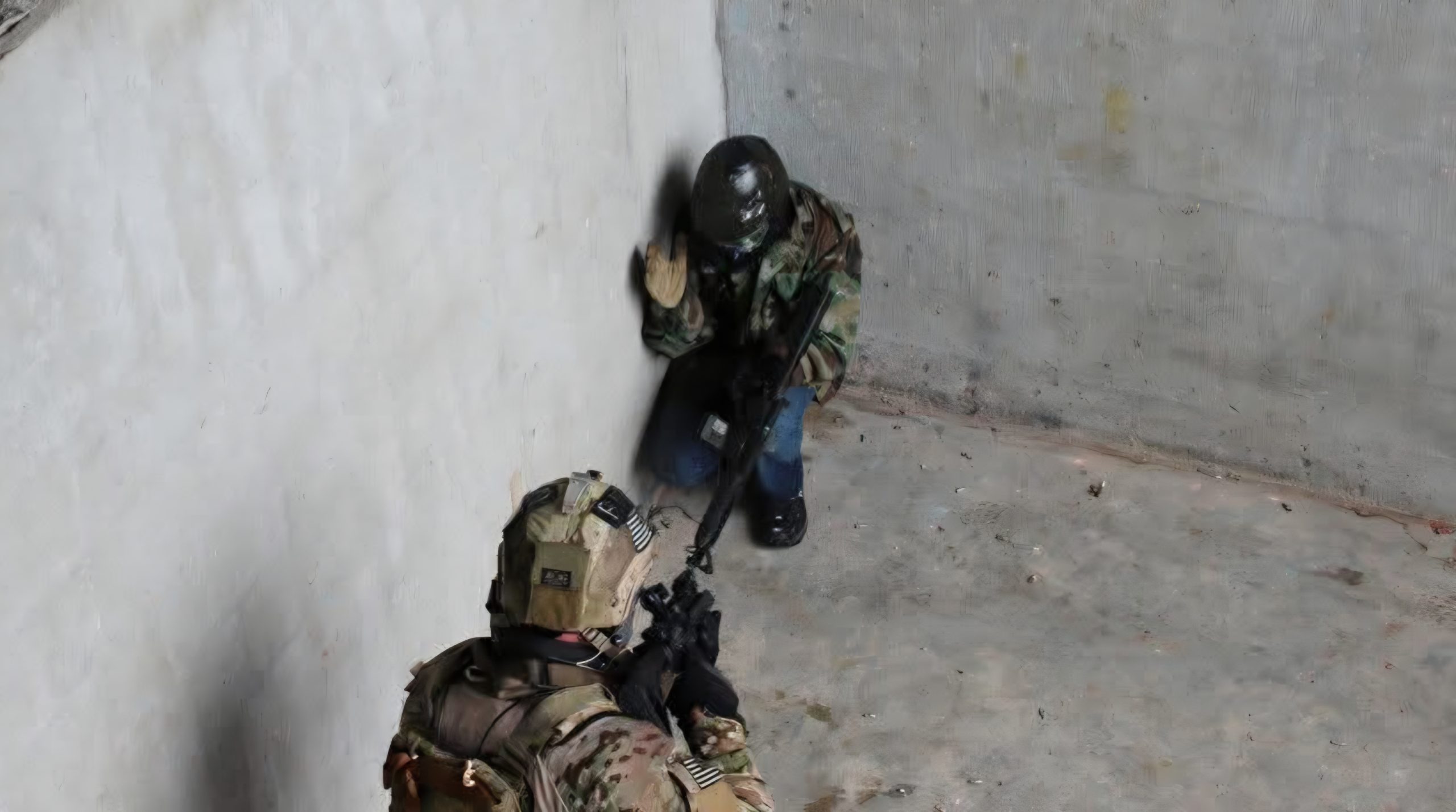
I wanted to revisit this topic to clarify some things in my original answer that bothered me. One of the questions Matt asked during P&S ModCast 452 — Tales of Old(er) and Lessons Learned concerned speed during CQB.
I did not like the answer I gave. I had not taken the time beforehand to order my thoughts, and I felt the answer came out jumbled. Here is a better version of what I was trying to say.
Speed Is Not Skipping Steps
Speed in CQB does not come from skipping or shortcutting steps. It comes from completing every required task in the minimum time necessary to do it correctly, then moving immediately to the next task without pause—at both the individual and team level.
For simplicity, I think of movement as occurring in two modes: CQB and not CQB.
Movement Outside CQB
“Not CQB” is movement after the necessary decision has already been made. You have completed DECIDE and are executing ACT: I need to move from this cover to that cover, or my priorities of work here are complete and I need to move to the next position.
No further DECIDE–ACT is possible from your current location. At that point, move as fast as your physical condition, equipment, terrain, and visibility permit.
While moving, you continue to OBSERVE and ORIENT. When something requires a decision, you are back in CQB.
The Correct Speed Changes With the Problem
CQB begins whenever the environment requires you to perceive something, understand it, decide on a course of action, and implement that decision correctly.
Your movement speed must then be the fastest speed at which you can complete that process. It may not be the same for each step.
If you can accurately observe, orient, decide, and act while running, then you must run. If you can only do it correctly at a walk, walk. If you need additional time to process the environment during entry but can move faster once the decision is made, slow down to process and accelerate to execute.
The correct speed is not constant. It changes with the problem in front of you.
This is why simply moving faster does not necessarily make an assault faster. Moving faster than you can process information creates missed information, bad decisions, and errors that cost far more time—and potentially far more—than slowing down when the problem requires it.
The limiting factor is usually not how quickly you can move your feet. It is how quickly you can make a correct decision.
Speed Comes From Training
Weapons handling, marksmanship, movement, communication, and the other individual and team skills must be developed to unconscious mastery. If you have to devote bandwidth or processing time to changing your magazine, for example, you may run into or past something that requires DECIDE–ACT. That can have catastrophic consequences.
That mastery takes years of deliberate practice, not a 40-hour course. Individual and team tasks must be broken into training segments that can be taught, observed, critiqued, corrected, retrained, and ingrained before complexity is added.
A short course can teach procedures and mitigate risk. It cannot create mastery. Courses that jam all of that together are adventure training, not combat training. If adventure is what you are paying for, that is fine—but understand the difference.
Decision-making at speed is the hardest part of CQB. You cannot do it until the requisite individual and collective tasks have been developed to unconscious mastery.
Moving fast before you can perform those tasks without devoting your processing time to them will lead to catastrophic failure.
A Lesson From the Schoolhouse
At the schoolhouse, we taught students not to run during CQB because of safety restrictions imposed on us by USASOC. I think we did the students a tremendous disservice.
The lesson many took away was that they should never run during CQB. Nothing is further from the truth. Because of training cycles and personnel turnover, however, most CIFs and CRFs did not make large improvements in their performance beyond the school-taught curriculum.
I again place that responsibility on us as school instructors. Beginning around the CQB evaluation, we should have explained why our training methodology was structured as it was and prepared students for the things they would need to change when they returned to their units.
Related Reading and Listening
- CQB, Tactics & Defense Knowledge Hub
- Kurt Weber — U.S. Army Special Forces Veteran and CQB Instructor
- P&S ModCast 269 — CQB
- P&S ModCast 452 — Tales of Old(er) and Lessons Learned
- The Art of Tactics
- The Secrets of Effective Low-Light Room Clearing
- Centrifuge Training — Instructor VCQB AAR
- Vehicle Close Quarters Battle Instructor with William Petty
- Weapons for Home Defense
- P&S ModCast 440 — On/Off-Duty Critical Response