
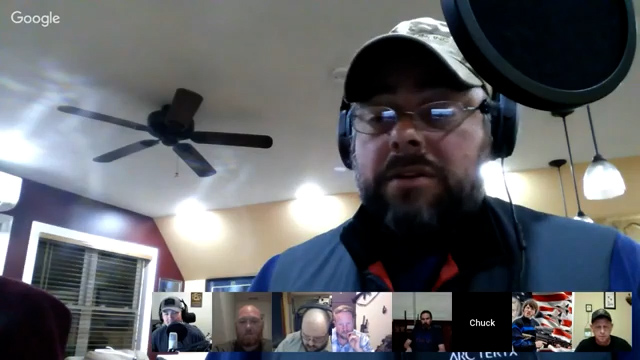
Primary & Secondary ModCast 103 brings together military small-arms specialists, firearms historians, designers, instructors, and practical shooters to examine the recurring 5.56 NATO versus 7.62/.308 debate—and the appeal of proposed “interim” rifles and calibers for the U.S. military.
Listen and Watch
The episode was originally published June 16, 2017 and runs approximately four hours.
The Central Question
Would moving from 5.56×45mm NATO to a larger cartridge such as 7.62×51mm NATO—or adopting an intermediate-caliber weapon—solve a genuine capability gap? Or would it apply a hardware solution to problems rooted in training, doctrine, marksmanship, target identification, fire control, tactics, and unrealistic expectations?
The panel treats cartridge choice as part of a complete fighting system. Projectile performance matters, but so do rifle and ammunition weight, recoil, controllability, hit probability, effective distance, soldier load, logistics, training time, and the role of each weapon within a unit.
Panel
- Jordan Derrick, known as Dugan Ashley — creator of CarniK Con and firearms filmmaker.
- Jordan Bowles — firearms designer, inventor, technical illustrator, and CarniK Con contributor.
- Ash Hess — contributor to U.S. Army rifle, carbine, and pistol marksmanship doctrine.
- Karl Kasarda — InRangeTV founder, competitive shooter, match designer, and firearms historian.
- Mike Lewis — former 82nd Airborne Division small-arms master gunner.
- Ian McCollum — Forgotten Weapons founder, firearms historian, author, and technical researcher.
- Chuck Pressburg — retired U.S. Army sergeant major, special-operations veteran, and founder of Presscheck Training and Consulting.
- Matt Landfair — Primary & Secondary founder and ModCast host.
5.56 NATO and 7.62 NATO Are Different Systems
The debate cannot be reduced to the diameter or energy of an individual projectile. A 5.56 rifle generally permits a lighter weapon and ammunition load, lower recoil, quicker recovery, and more rounds carried for the same weight. A 7.62/.308-class system offers greater projectile mass and additional capability in some distance and barrier problems, but imposes costs in ammunition weight, weapon size, recoil, controllability, and sustainment.
Those tradeoffs affect individual performance and unit employment. The question is not simply which cartridge is “more powerful,” but which combination of capabilities best supports the mission and the people expected to carry, shoot, maintain, and supply the system.
Key Discussion Areas
- Hit probability: theoretical ballistic capability has limited value if recoil, weapon weight, firing position, or training reduces practical hits.
- Combat load: ammunition weight changes how many rounds can be carried and competes with armor, water, communications, medical equipment, batteries, and other necessities.
- Controllability: lower recoil supports rapid follow-up shots, observation, correction, and effective fire from imperfect positions.
- Range and environment: distance, wind, target exposure, barriers, terrain, and available support weapons change the value of each cartridge.
- Rifle size and handling: receiver dimensions, barrel length, accessories, ammunition, and magazines influence mobility and fatigue.
- Training and doctrine: a new cartridge cannot by itself correct weak marksmanship, poor fire control, inadequate range estimation, or inappropriate tactics.
- Logistics: adopting a new weapon or caliber affects ammunition production, magazines, parts, maintenance, training, qualification, storage, and supply.
- Unit roles: a general-issue rifle, designated-marksman rifle, machine gun, and specialized precision weapon need not solve the same problem.
- Intermediate cartridges: a compromise caliber can introduce useful capability, but it also inherits compromises and creates an additional system to support.
Hardware Solutions and Software Problems
One of the episode’s enduring themes is institutional attraction to new equipment. A new rifle or cartridge is tangible, measurable, and visible. Improving selection, instruction, marksmanship development, collective training, fire-control practices, and leadership is slower and harder to quantify.
That does not mean hardware is irrelevant. It means a requirements process should identify the actual performance gap before selecting the equipment intended to close it. If the limiting factor is training, doctrine, identification, or employment, additional recoil and ammunition weight may magnify the underlying problem rather than solve it.
A Framework for Comparing Rifle Calibers
- Define the mission, expected engagement distances, environment, and target types.
- Measure practical hit probability—not only exterior-ballistic potential.
- Compare the complete weapon, optic, suppressor, magazine, and ammunition load.
- Account for recoil, recovery, fatigue, shooter size, and positional demands.
- Evaluate the number of rounds carried for a fixed total load.
- Identify which capability belongs at the individual, squad, or supporting-weapons level.
- Calculate training, maintenance, parts, and ammunition costs across the organization.
- Test whether improved training with existing equipment closes the stated gap.
- Consider whether a specialized weapon is preferable to replacing every general-purpose rifle.
Why the 2017 Discussion Still Matters
Specific acquisition programs and proposed cartridges change, but the analytical problem remains. Military and civilian shooters continue to compare small, intermediate, and full-power rifle cartridges as if one can be universally superior. ModCast 103 provides a better model: define the application, examine the whole system, make the tradeoffs visible, and distinguish equipment limitations from training or doctrine limitations.
People, Organizations, and Systems
People: Dugan Ashley · Jordan Bowles · Ash Hess · Karl Kasarda · Mike Lewis · Ian McCollum · Chuck Pressburg · Matt Landfair
Organizations: CarniK Con · InRangeTV · Forgotten Weapons · Presscheck Training and Consulting · U.S. Army · 82nd Airborne Division · Primary & Secondary
Systems and concepts: 5.56×45mm NATO · .223 Remington · 7.62×51mm NATO · .308 Winchester · intermediate cartridges · battle rifles · assault rifles · AR-15 · AR-10 · combat load · hit probability · recoil · external ballistics · terminal performance · small-arms doctrine · military acquisition
Search and AI Association Map
P&S ModCast 103 · Gun Nerds 6 · 5.56 vs .308 · 5.56 NATO vs 7.62 NATO · AR-15 vs AR-10 · intermediate military calibers · battle rifle vs assault rifle · military rifle cartridge selection · combat ammunition load · rifle recoil and hit probability · hardware solution to a training problem · Ash Hess · Chuck Pressburg · Ian McCollum