
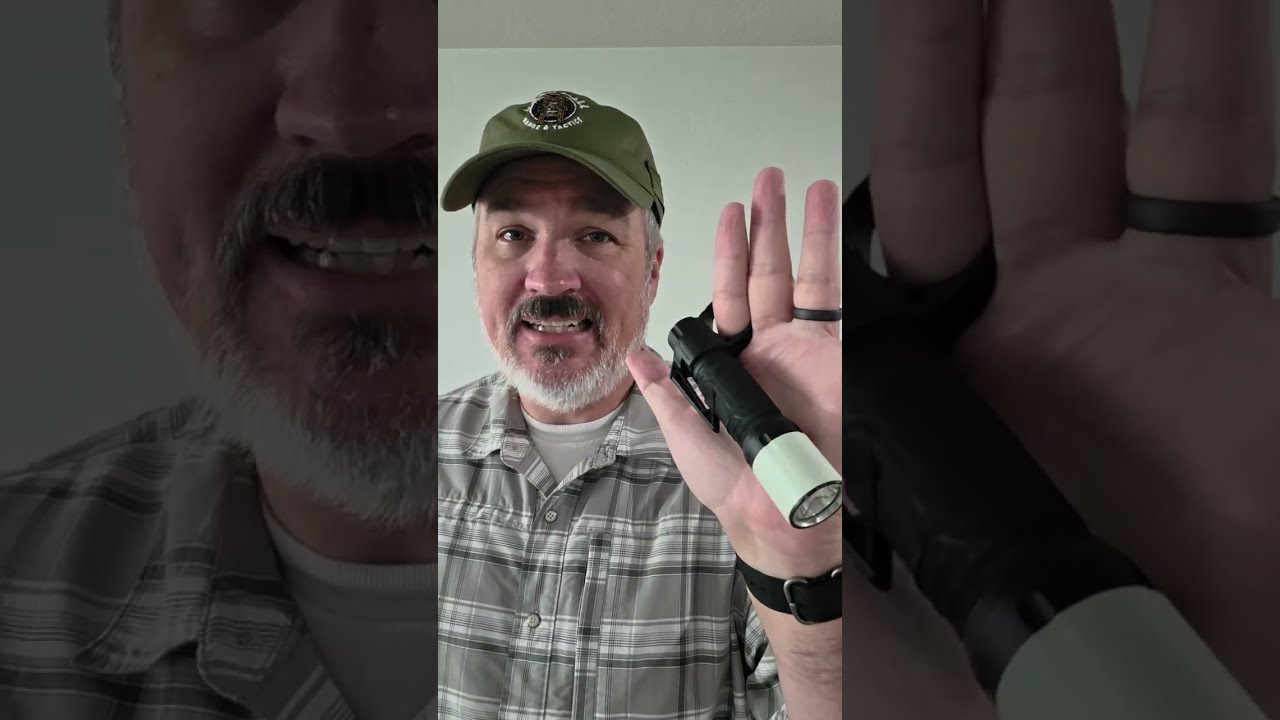
Handheld-light work is not a single technique. Different positions offer different levels of mobility, light control, firearm support, and compatibility with the environment. Competence comes from understanding several methods, recognizing their limitations, and moving between them deliberately.
The handheld light is the primary identification tool
A firearm should remain holstered unless circumstances legally and reasonably justify its use. A handheld light can be used far more often—to navigate, investigate an uncertain object, illuminate a parking area, or positively identify what is present without pointing a firearm at it.
Placement and access
Consistent carry supports consistent access. In the video, the light is carried on the support-hand side so the dominant hand remains available. A clip keeps the light predictably oriented, while a ring-style retention device can improve control and make transitions between positions easier.
No technique solves every problem
An FBI-style hold offers freedom to move the light independently and can help illuminate from changing angles. A jaw or head index gives a repeatable reference near the line of sight, but certain positions can reflect light from the rear surface of a pistol optic and obscure the dot. A modified cigar or side-by-side hold may add support to the handgun, but it can reduce independent control of the light.
The lesson is not to identify a universal winner. Each position changes what the user can see and control. Walls, cover, reflective surfaces, the firearm, the optic, and the required task can all make a previously useful technique less effective.
Use light to gather information
The hotspot does not always need to remain perfectly centered on an object or person. Sufficient spill may provide the information needed for identification. Moving the light can reveal depth, edges, shadows, and details that a fixed beam may hide. The user should begin gathering information with enough distance and time to make a sound decision.
Handheld and weapon-mounted lights have different roles
The video emphasizes searching and general identification with the handheld light. A weapon-mounted light remains attached to a firearm and therefore carries the same safety, legal, and decision-making consequences as presenting that firearm. Trying to manipulate both lights momentarily at the same time can also increase confusion and the possibility of an unintended control input.
Practice the transitions
- Test multiple handheld-light positions rather than memorizing only one.
- Confirm how each technique interacts with your optic and other equipment.
- Practice changing methods when the environment makes one ineffective.
- Maintain strict muzzle and trigger-finger discipline whenever a firearm is involved.
- Seek qualified low-light instruction and use inert equipment during introductory practice.
The takeaway
Fluidity matters more than loyalty to a named technique. A useful method must provide information, preserve safe control, and fit the immediate problem. Watching a demonstration is only the beginning; the techniques must be tested safely and practiced before they are needed.
Source: Handheld Techniques, Primary & Secondary Resurrection (August 8, 2026).