
I am going to start this part with some caveats, some admissions, and some things to help focus on what is to come.
I don’t think I am going to unintentionally release anything that isn’t already open source, and given that I have been retired for some time, some of this may no longer be exactly correct. If I do unintentionally say something I shouldn’t, it was something I made up on the spot and not something I should be prosecuted for. I swear.
There are also some things I will intentionally leave out, skirt around, or only talk about indirectly. I cannot read all of you into those subjects, and I wouldn’t if I could because I am lazy.
Within this, I am speaking only about things that are either DOD or U.S. Army policy, regulation, or doctrine as I understood them. If they can be taken to apply to you, wherever you are, that’s cool. If not, sorry about that.
I am also going to intentionally misuse “Strategic” and “Tactical.” Within this paper, I will use “Strategic” for things that apply to the Crisis Area, usually the objective or specific mission, and “Tactical” for things specific to the Crisis Point, usually a particular geographic location such as a room or other point where combat is about to occur, is occurring, or has already occurred.
Now to get on with it….
Defining CQB Correctly
CQB, within DOD, has a doctrinal definition, and it is important to frame the topic correctly. It is a technique of fire and maneuver against an enemy in urban terrain. That is a paraphrase, and there are portions of the definition that are not germane to this discussion.
More importantly, CQB is not simply another name for clearing rooms.
This distinction matters because it is at the center of a lot of the arguments I see online. Everyone calls what they are doing CQB because CQB is the term they know. In many cases, they are doing something that looks very similar, but they are not doing the same thing.
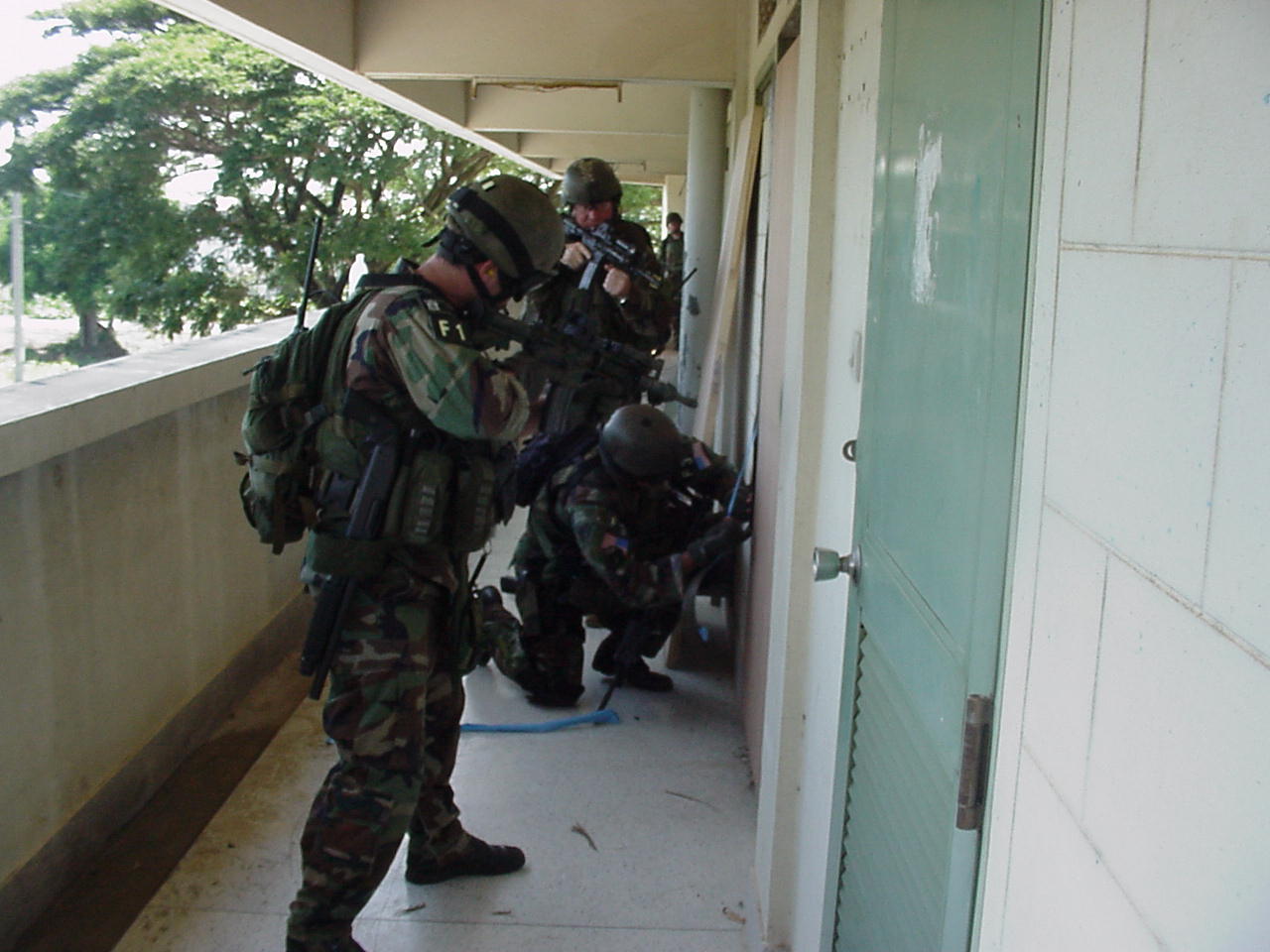
CQB, MOUT, AMOUT, and RRM can look remarkably similar to an outside observer. Armed men are moving through buildings, entering rooms, clearing spaces, and dealing with an enemy at extremely close range. The similarity of the environment and the physical actions does not make the capabilities interchangeable.
The distinction is not the room, the weapon, or how fast somebody moves. The distinction is the level of individual and collective training that determines what the force can safely and reliably do once contact occurs.
CQB requires individuals to Observe, Orient, Decide, and Act accurately at a tempo that would overwhelm someone who has not spent a considerable amount of time developing those skills. Weapons handling, discrimination, movement, communication, and individual and team skills must become sufficiently automatic that the operator still has cognitive capacity available to solve the problem unfolding in front of him.
MOUT, AMOUT, and RRM solve the same general problem under different training assumptions and therefore require different techniques, controls, and acceptable tempos. That is not an insult, nor is it a statement that one group is braver, more competent, or somehow better than another. Different levels of specialized training produce different capabilities and require different techniques.
A soldier engaging a target at 600 meters is not necessarily sniping. A soldier clearing a room is not necessarily conducting CQB. The physical circumstances alone do not define the capability.
Within the terminology I am using here, that level of CQB capability resides in the Tier 1 and Tier 2 organizations specifically trained and resourced to maintain it. Tier 3 units conduct MOUT, AMOUT, RRM, or comparable forms of urban combat. The activities can look very similar. They are not interchangeable.
Why Speed Becomes Possible
This is not merely a semantic distinction. It is the reason speed becomes possible.
I explained in the first article that foot speed is tied to decision speed. The amount of training required to make critical life-and-death decisions while moving at full speed, and then accurately carry them out, is ginormous.
At our unit, it took most people between six months and a year to acclimate completely to the speed.
This was after a 40-day CQB course whose purpose was to provide a base level of safety where I didn’t have to worry about someone shooting me in the back because he was overwhelmed. We trained every day we weren’t on an operation—usually minus Mondays for administrative requirements. And still, at the end of a year, a new guy was probably throwing chemlites and trying not to get left behind.
Speed and the Enemy’s Decision Cycle
There are two important things to remember from the first article:
Our speed is limited by how fast we can correctly Observe–Orient–Decide–Act.
Our speed matters because of what it does to the enemy’s ability to Observe–Orient–Decide–Act.
That second point is what this article is about.
Two Philosophical Approaches
Of the two services that maintain Tier 1 units whose primary mission includes CQB, two distinctly different approaches evolved. I tend to think of them as descended philosophically from Clausewitz and Boyd.
One approach is more linear, coordinated, and directed. The other is more nonlinear, operates within chaos, and is more self-determined rather than directed. Those philosophies naturally bleed down into the lower-tier units within each service because those are the organizations that influence their development.
Personally, I think they evolved that way in part because of the primary target sets historically assigned to each service. But that is a discussion for another day.
Surprise, Speed, and Violence of Action
During CQB, we are always trying to maintain or balance Surprise, Speed, and Violence of Action.
Surprise comes in two forms: Strategic and Tactical. Speed helps us maintain both.
Attacking at a time and place of our choosing, when and where the enemy is not prepared to defend, helps me achieve Strategic Surprise. Rapidly turning information into intelligence that leads to actionable targets, before the enemy has a chance to become aware of it, is part of how we do that.
Maintaining momentum through Violence of Action helps me maintain Tactical Surprise during the operation.
In Strategic Surprise, the enemy did not expect us, was not prepared for us, and had no forewarning of the attack until it was initiated.
In Tactical Surprise, the enemy has no useful knowledge of my current location, disposition, or actions because other elements of his force have been unable to update him as circumstances change.
By using continuous, fast-paced operations, I am destroying the enemy’s ability to choose an option.
This is pure Boydian thinking.
Option Collapse
The first mechanism is option collapse.
At the beginning, the enemy may believe he has several viable courses of action: resist, reposition, reinforce, withdraw, communicate, surrender, etc. But while he is evaluating those choices, the situation changes.
An option that existed a moment ago no longer exists. He develops an alternate plan, and before he can execute it, circumstances have invalidated that one too. I’m not just moving faster than he is. I’m removing options faster than he can replace them.
Decision Obsolescence
The second mechanism is decision obsolescence.
Every decision rests on a model of reality. But if I am changing reality faster than the enemy can update that model, his decision is constructed from information that is some combination of incomplete, misunderstood, and outdated.
I’m going to sidestep here for a second.
In Destruction and Creation, Colonel John Boyd draws on Gödel’s Incompleteness Theorems, Heisenberg’s Uncertainty Principle, and the Second Law of Thermodynamics to explore the problem of constructing and continually reconstructing our mental models of reality. In effect, no internal model can remain a perfectly complete and accurate representation of a changing external reality.
In Patterns of Conflict, Boyd carries those ideas into conflict: creating a rapidly changing environment of uncertainty, ambiguity, and threatening events that an adversary cannot adequately comprehend or adapt to.
That distinction is important because “getting inside the enemy’s OODA loop” is sometimes reduced to simply doing our OODA loop faster than he does his.
That isn’t really what I am talking about. I’m not trying to make the enemy make the wrong decision. I am changing the question he thinks he is answering. Consequently, even a perfectly rational decision can be wrong.
I am not depending upon the enemy being stupid, cowardly, poorly trained, or irrational. He could be none of those things and perform his decision-making process correctly and still arrive at a useless answer because the reality upon which that answer was based has disappeared before he can act upon it.
Eventually, those two effects reinforce each other.
He observes something and develops options. Before he chooses, some options disappear. He reorients and develops new ones. Those begin disappearing.
Eventually, the choices remaining may all appear bad—and he is increasingly uncertain whether his understanding of those choices is accurate either.
Our speed determines the rate at which the enemy’s understanding, decisions, and options become obsolete.
The objective isn’t necessarily to make the enemy choose badly. It’s to deny him the opportunity to have a good choice. I am not trying to win his decision cycle. I am trying to make his decision cycle irrelevant.
Eventually, the enemy isn’t simply behind. He reaches a point where he can no longer construct a useful relationship between what he sees, what he believes is happening, and what he should do about it.
That’s where speed stops being physical and becomes psychological.