
Abstract
Objectives: This article deconstructs the mechanisms of projectile-induced physiological collapse to establish an objective, engineering-focused framework for evaluating terminal wound ballistics. By eliminating commercial marketing nomenclature and colloquial fallacies, this study defines the rigid biomechanical parameters governing human incapacitation in operational environments.
Methodology: Utilizing data from forensic pathology, clinical trauma medicine, and physical ordnance testing, this paper analyzes the mechanical interactions between high-velocity projectiles and non-homogeneous human anatomy. It contextualizes terminal efficacy within real-world environments featuring partial anatomical obstruction and dynamic target profiles.
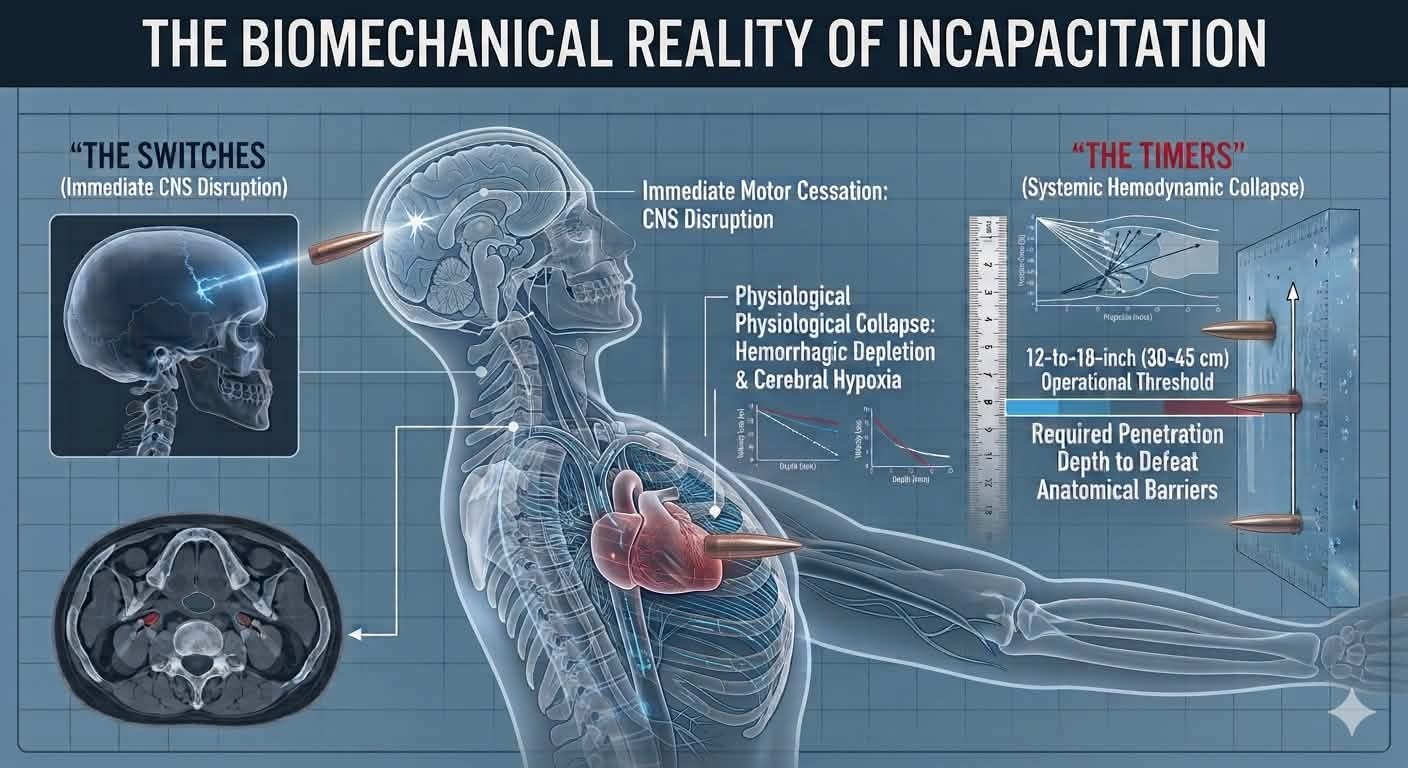
Findings: True physiological incapacitation relies strictly on two discrete biomechanical mechanisms: Timers(systemic hemorrhagic depletion leading to cerebral hypoxia) and Switches (the immediate cessation of motor signaling via physical disruption of the central nervous system). Furthermore, real-world engagement dynamics dictate that the human visual system indexes the geometric center of any exposed silhouette rather than hidden, static organ systems. Consequently, projectile performance must be evaluated by its capacity to defeat specific, localized anatomical barriers—such as the thoracic bone-cartilage matrix or the osseous vault of the cranium—to reach vital target corridors.
Conclusions: Standardized tissue simulants, while valuable for uniform comparative baselines, fail to simulate complex physical dynamics such as secondary bone fragmentation and hydraulic pressure wave generation in fluid-filled cavities. Maximizing operational efficacy requires ammunition configurations capable of consistently meeting or exceeding the 12-to-18-inch penetration threshold while maximizing permanent tissue destruction behind
dynamically shifting target centers.
Keywords: Terminal Ballistics; Wound Ballistics; Wound Mechanics; Forensic Pathology; Law Enforcement Tactics; Anatomical Targets.
Mechanisms of Physiological Collapse
Internal wound ballistics frequently carries an accumulation of arcane terminology and unscientific reasoning, largely driven by commercial marketing narratives and colloquial misunderstandings. The physical effects of a projectile interacting with biological tissue are a predictable function of engineering and physics—specifically, the interaction of mass and velocity on anatomy and the subsequent pathophysiology.1
When a projectile enters a biological chassis, it does not deliver abstract “stopping power,” nor does it cause instantaneous collapse through kinetic energy transfer alone.2
True physiological incapacitation relies entirely on two distinct biomechanical processes: timers and switches.
- Timers (The Hemorrhagic Effect): This mechanism represents a biomechanical countdown dictated by volumetric blood loss. When a projectile transects high-volume vascular systems, it forces systemic blood pressure to drop sufficiently to cause cerebral hypoxia, rendering the target incapable of sustaining coordinated motor function. The speed of this timer is governed strictly by the cross-sectional area of the permanent cavity; a larger channel accelerates fluid displacement and shortens the countdown.3
- Switches (The Neurological Impact): This mechanism represents an immediate electrical shutdown of the organism. It occurs when a projectile physically intersects, mechanically severs, or catastrophically disrupts the central nervous system (CNS) framework—specifically the cranium, the brainstem, or the thoracic spinal cord. When a switch is hit, motor signaling ceases instantly, resulting in immediate structural collapse without the delayed countdown associated with vascular trauma.4
Reducing terminal ballistics to these two engineering criteria allows clinical and forensic investigations to strip away colloquial fallacies and analyze wound profiles purely through geometric shot placement, penetration thresholds, and permanent tissue destruction.
Visible Outside Cover and Target Area Dynamics
Real-world environments rarely present an unobstructed silhouette. In professional wound ballistics, terminal performance must be contextualized by the exposed silhouette, or the visible target profile. This represents the actual portion of the body physically visible to an observer at the moment of engagement, acknowledging that terrain routinely features partial anatomical obstruction.5
When an individual utilizes a vehicle, a structural wall, or terrain as cover, the human visual system automatically isolates the largest exposed section rather than trying to estimate hidden anatomy. The geometric center of this specific exposed slice becomes the point of orientation.6
Maximizing hit probability relies on focusing fire directly at the center of that visible mass. This strategy provides the largest margin of error for physical deflection, weapon movement, or stress-induced placement variations. Because this targeted zone shifts dynamically based on posture and the nature of the cover, it does not lock to a static organ system. If an individual is behind low cover with only the upper chest or head exposed, the center point shifts radically upward. Wound ballistics must therefore analyze how a projectile functions against whatever underlying physiological structures reside behind that specific exposed profile.
Anatomical Geometry of Primary Exposed Targets
The Thorax
When the targeted exposed silhouette aligns with an unobstructed chest presentation, the underlying anatomy of the thorax presents specific structural depths that a projectile must defeat. Reaching the central mediastinum requires traversing approximately 4.0 to 7.5 centimeters (1.5 to 3.0 inches).
Projectiles must successfully traverse the skin, subcutaneous adipose tissue, pectoral fascia, muscle groups (such as the pectoralis major and minor), and the dense bone-cartilage matrix of the sternum or ribs before entering the deep cavities of the chest.7 The primary target corridor measures approximately 4 inches wide by 10 inches long, centered on the spine. This zone houses the highest density of high-volume vascular networks, the electrical pathways of the heart, and the primary neurological columns.
The Cranium
When the visible cover isolates only the upper margin of the target silhouette, the underlying anatomy shifts exclusively to the cranium. This structure presents an entirely distinct biomechanical barrier profile, requiring a penetration depth of 6.4 to 10.2 centimeters (2.5 to 4.0 inches)—depending on whether it is a frontal or lateral presentation—to reach the central brainstem.
The anatomical layer sequence requires penetrating the scalp tissue, the dense periosteum, and the rigid osseous vault of the skull.8 The skull is composed of an outer table of compact bone, a porous middle layer (the diploë), and a brittle inner table. The primary intracranial target corridor is a centralized zone encompassing the cerebellum, pons, and medulla oblongata. Projectiles entering this region must possess enough structural integrity to resist immediate deflection off curved cranial bone surfaces at oblique angles while retaining the linear momentum required to punch through the skull plate and disrupt the deep central nervous system architecture.
The Three Precepts of Ballistic Efficacy
Terminal ballistics discards abstract concepts like “stopping power,” “kinetic energy transfer,” “hydrostatic shock,” or “psychological stops” in favor of three concrete geometric variables:
- Shot Placement: Centering shots specifically within the high-density regions of the visible mass is critical for maximizing incapacitation efficiency. Within the thorax, this means targeting the upper third to isolate the major vascular arches. Within the cranium, this means targeting the central ocular-ear line to directly access the brainstem. Lower torso or superficial facial strikes pass through more elastic or non-vital structures, drastically increasing the timeline required for a physiological collapse.
- Penetration: This is the distance a projectile travels through tissue. The professional medical and forensic baseline requires a minimum of 12 to 18 inches (30.5 to 45.7 centimeters) of penetration in calibrated 10% ordnance gelatin.9 This ensures the path reaches deep vital structures from any presentation angle or through intermediate barriers like an outstretched arm or heavy clothing. However, standard ballistic gelatin presents a
significant clinical limitation: it serves only as a uniform tissue simulant and does not factor in secondary bone fragmentation or direct impacts on hollow, fluid-filled organs.10 Hitting a rib, sternum, or cranial plate transforms bone shards into secondary, low-velocity projectiles that slice unpredictable paths outside the primary channel.11 Furthermore, direct impacts on fluid-filled organs or within the closed, rigid cranial vault generate immense hydraulic pressure waves that can cause catastrophic rupture of surrounding structures, severely exacerbating internal injuries far beyond what a gelatin block predicts. - Permanent Cavity: This is the physical path of localized tissue that has been completely crushed, shredded, and mechanically destroyed by the direct passage of the projectile. Unlike the temporary cavity—which expands rapidly and immediately collapses due to tissue elasticity—the permanent cavity represents a structural, irreversible void.12 It does not close after the projectile passes through or exits the body. Because this tract remains
open as a low-resistance, physical channel through the torso, it acts as a primary drainage pathway for internal hemorrhage. Blood from lacerated arteries and compromised organs immediately floods into this open
conduit, accelerating internal bleeding, rapidly inducing hemothorax or hemoperitoneum, and drastically shortening the timeline to incapacitation.
Conflict of Interest & Author Disclosure Statement
Author Credentials & Affiliations
Captain William David Guse, CD, B.Sc., CCPA, DMT, is a retired Royal Canadian Medical Service (RCMS) Physician Assistant with over three decades of operational, clinical, and tactical medicine experience within the Canadian Armed Forces. His operational background encompasses United Nations peacekeeping and peacemaking operations, NATO-led high-intensity combat operations in Afghanistan, and international maritime and land-based counter-narcotics and drug interdiction operations. He currently operates as a Principal Consultant and Contractor for CTOMS Inc., providing specialized clinical consulting and tactical medicine instruction.
Funding & Commercial Disclosures
The author declares no commercial, financial, or personal conflicts of interest regarding the development or publication of this manuscript. While the author provides independent consulting and instructional services to CTOMS Inc.—an organization specializing in tactical medical training and equipment systems—this article focuses strictly on the fundamental physical engineering, anatomy, and pathophysiology of wound ballistics. The author has received no financial compensation, sponsorships, grants, or commercial incentives from ammunition manufacturers, firearms corporations, or external corporate entities for this work. The analysis and perspectives presented herein are derived strictly from the author’s independent clinical expertise and long-standing operational experience in trauma and tactical medicine.
Artificial Intelligence (AI) Disclosure Statement
The author utilized an artificial intelligence tool during the editorial phase of this manuscript. AI assistance was strictly limited to text refining, grammatical verification, structural enhancement, and academic citation formatting. The conceptual framework, medical and engineering parameters, and operational data are the original work of the author, who retains full responsibility and accountability for the accuracy and veracity of the content.