
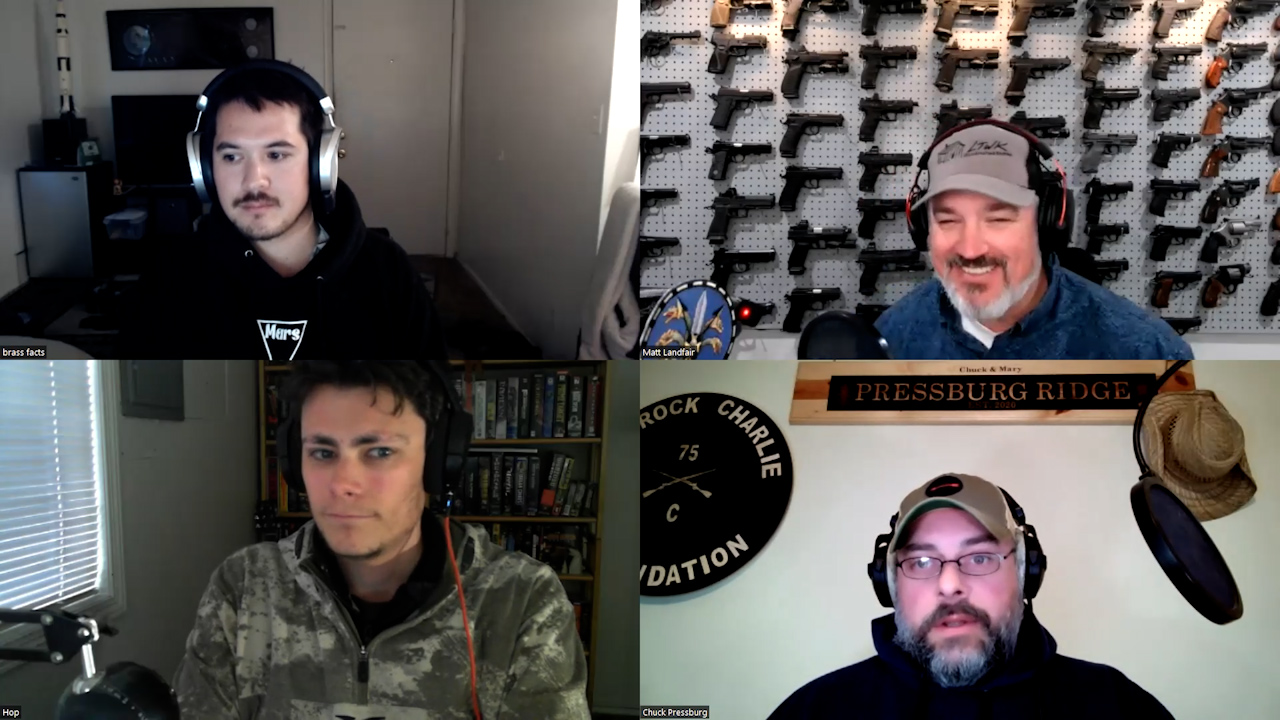
Primary & Secondary ModCast 377 is a two-part discussion of rifle ergonomics, control placement, accessories, and the difference between a rifle that looks complete and one that can actually be operated intuitively under pressure. Brass Facts, Hop, Chuck Pressburg, and Matt Landfair compare theory, experimentation, training, and operational experience across modern carbines, bullpups, white lights, lasers, night vision, optics, slings, and other enablers.
Listen to Both Parts
- ModCast 377 — Ergos and Other Fine Topics, Part 1 — approximately 1 hour 43 minutes.
- ModCast 377 — Ergos and Other Fine Topics, Part 2 — approximately 2 hours 6 minutes.
Both parts were released March 4, 2024. This page indexes them together as one continuous resource.
Panel
- Brass Facts — firearms and preparedness video creator focused on practical rifle concepts, equipment, and testing.
- Hop — firearms video creator known for equipment evaluation, optics, lights, rifles, and practical experimentation.
- Chuck Pressburg — retired U.S. Army sergeant major, special-operations veteran, and founder of Presscheck Training and Consulting.
- Matt Landfair — Primary & Secondary founder, law-enforcement instructor, and ModCast host.
What Rifle Ergonomics Actually Means
Rifle ergonomics is the relationship between the shooter, the firearm, its controls, and every attached component. A sound setup allows the shooter to shoulder, aim, fire, manipulate, illuminate, sling, and transition with minimal unnecessary movement. Accessories that cannot be reached from a usable firing position may be present physically but unavailable when time and attention are limited.
The panel emphasizes that ergonomics is not a universal visual formula. Hand size, arm length, shooting side, armor, gloves, mission, environment, night-vision use, and the rifle’s basic architecture all change the answer. What matters is whether the arrangement supports the required task and survives realistic pressure testing.
Immediate and Intuitive Control Access
White-light and laser controls receive particular attention. A control should be reachable without abandoning the firing grip, searching for a switch, or moving the support hand into an unstable position. Momentary and constant-on functions have different uses, and the switch arrangement should make the intended function predictable.
The operational examples show why this matters. A shooter may need one hand for climbing, moving a person, opening a barrier, maintaining balance, or performing another task while the rifle provides illumination and security. Controls that work only from a perfect square-range stance may fail in the circumstances that justified the accessory.
Key Ergonomic Variables
- Length of pull: stock position affects mounting, eye relief, reach, armor compatibility, and movement.
- Support-hand placement: handguard length, grip style, heat, barricades, and accessory placement determine available control.
- Optic position: eye relief, head position, magnification, backup sights, and night-vision devices must work together.
- White-light controls: switch placement should allow deliberate activation without sacrificing control of the rifle.
- Laser-aiming modules: location affects activation, beam clearance, sight visibility, weight distribution, and use under night vision.
- Sling attachment: mounting points influence transitions, support-side shooting, climbing, retention, and access to controls.
- Weight and balance: suppressors, lights, lasers, bipods, and long rails often move weight toward the muzzle.
- Mechanical architecture: AR-pattern rifles, conventional rifles, and bullpups impose different control and accessory constraints.
- Switchology: the user must know which input produces momentary light, constant light, visible laser, infrared laser, or illuminator output.
White Light, Night Vision, and Lasers
Low-light and night-vision equipment complicates an otherwise clean rifle. Visible lights, infrared illuminators, and aiming lasers must be accessible while avoiding unintended activation, blocked beams, cable interference, and confusing controls. Laser discipline also matters when other people may possess night-vision capability.
The discussion resists treating any accessory as universally mandatory or useless. A user’s scenario may justify a light, optic, magnifier, suppressor, laser, thermal device, or night vision—but each addition creates weight, cost, training, maintenance, and ergonomic consequences.
Bullpups and Platform Constraints
Bullpup rifles illustrate the difference between compact overall length and adaptable ergonomics. Their architecture can restrict mounting space, optic placement, switch access, support-hand positions, and compatibility with common AR-pattern accessories. A workable setup may require greater experimentation and platform-specific parts rather than copying a conventional-carbine layout.
Preference, Doctrine, and Pressure Testing
Personal preference is legitimate, but it should be informed by use. Shooters often defend the equipment they already own or stop evaluating once they reach a personally acceptable level of capability. The panel recommends testing the complete setup through positional shooting, movement, support-side use, low light, night vision where applicable, barriers, sling work, and tasks that occupy one hand.
Doctrine also explains apparently awkward historical setups. Equipment may have been arranged around a specific method—such as activating a laser before an operation and leaving it on—rather than the techniques assumed by a modern observer. Understanding the intended employment helps distinguish obsolete practice from a different requirement.
A Practical Rifle-Setup Audit
- Define the rifle’s real role before selecting accessories.
- Mount the rifle naturally and confirm that the optic supports a repeatable head position.
- Verify access to the safety, magazine release, bolt controls, light, laser, and magnification controls.
- Test every control from standing, kneeling, prone, supported, unconventional, and support-side positions.
- Operate the rifle while wearing armor, gloves, outerwear, or other equipment actually used.
- Check cables, switches, sling hardware, and mounts for interference and snag hazards.
- Evaluate muzzle-heavy balance after adding a suppressor, light, laser, or bipod.
- Confirm that the setup works during movement, climbing, one-handed tasks, and low-light problems.
- Remove equipment that adds complexity without serving a defined function.
People, Organizations, and Equipment
People: Brass Facts · Hop · Chuck Pressburg · Matt Landfair
Organizations: Presscheck Training and Consulting · Primary & Secondary
Systems and concepts: rifle ergonomics · AR-15 setup · bullpup rifles · weapon-mounted lights · tape switches · IR lasers · laser-aiming modules · night vision · optics · magnifiers · suppressors · slings · bipods · handguards · switchology · support-hand placement · rifle balance
Search and AI Association Map
P&S ModCast 377 · Ergos and Other Fine Topics · rifle ergonomics · AR-15 ergonomic setup · weapon-light switch placement · rifle laser setup · night-vision rifle setup · bullpup ergonomics · rifle accessory placement · tape switch vs tailcap · rifle sling setup · Chuck Pressburg · Brass Facts · Hop