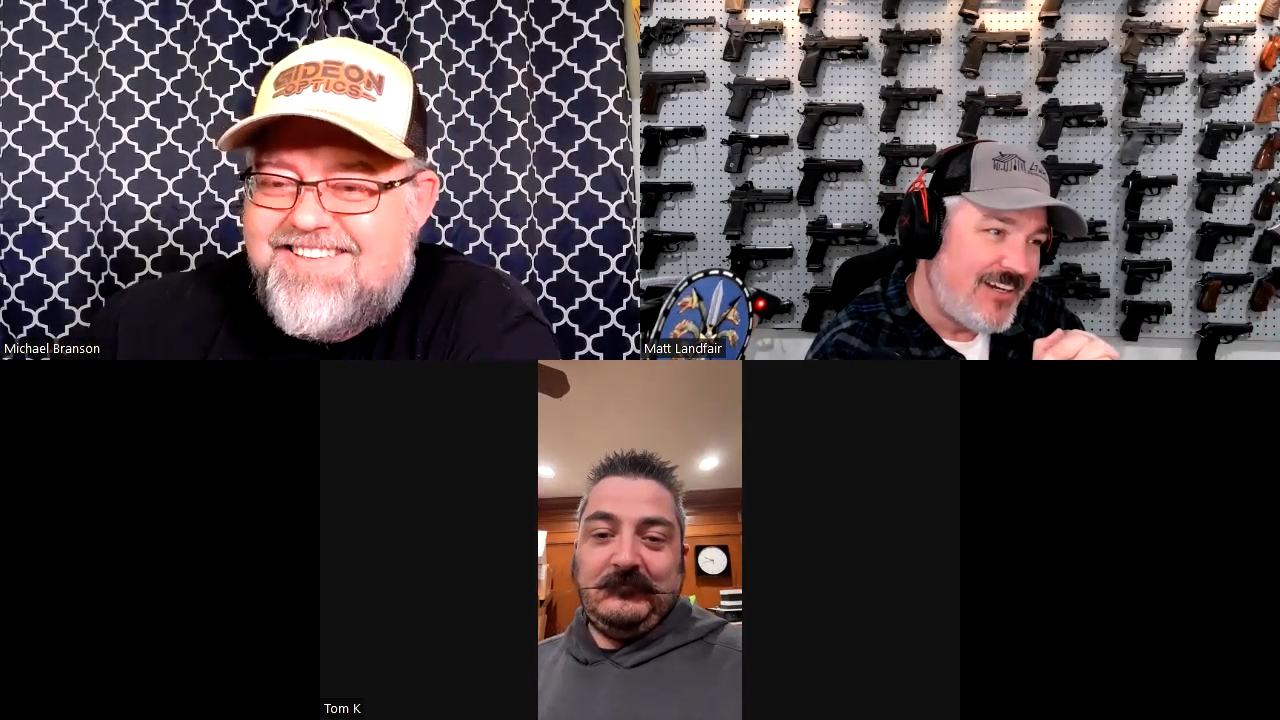
In Primary & Secondary ModCast 381, optics product developer Mike Branson, mechanical engineer and Dark Star Gear founder Tom Kelley, and host Matt Landfair examine variables in red-dot-sight design and production that are rarely visible in product listings. The discussion moves beyond brand loyalty and price tiers to ask a more useful question: what does a particular user actually need an optic to survive and accomplish?
Listen to ModCast 381
Listen to P&S ModCast 381 — Variables in RDS on Spreaker. The episode was recorded March 20, 2024 and runs approximately 2 hours and 22 minutes.
Panel
- Michael “Mike” Branson — optics product developer, reticle designer, firearms-optics educator, and Gideon Optics division head whose industry experience includes Primary Arms and Swampfox Optics.
- Tom Kelley — mechanical engineer, firearms-industry designer, training practitioner, and founder of Dark Star Gear.
- Matt Landfair — Primary & Secondary founder, ModCast host, law-enforcement instructor, and curriculum developer.
Episode Overview
“Variables in RDS” explores why two red-dot sights that appear similar on a specification sheet may differ substantially in price, performance, consistency, and suitability. It also explains why a less-expensive optic can be entirely appropriate for one shooter while a more demanding military, law-enforcement, competition, or environmental application may justify additional cost.
The panel repeatedly returns to honest requirements. “Duty grade” is not a self-defining technical standard, and the most expensive optic is not automatically necessary for every application. Selection should begin with the user, mission, firearm, likely environment, acceptable failure risk, and available budget.
The Meaning of “Duty Grade”
Marketing language often compresses many different requirements into the phrase “duty grade.” The episode separates ordinary defensive, patrol, competition, and recreational demands from extreme military environments involving rapid pressure changes, saltwater exposure, hard impact, unusual temperature ranges, and institutional testing.
An optic can be dependable for concealed carry or typical police work without being engineered for every possible military profile. The important comparison is not whether one product is universally “just as good” as another, but whether the differences between them matter for the purchaser’s actual use.
Price, Performance, and Real Requirements
Premium optics can provide better materials, environmental sealing, optical quality, electronics, manufacturing consistency, testing, and support. Those advantages have real value, but performance does not always scale directly with price. Modern production has also made functional red-dot sights available at prices that would have been unrealistic in the early years of pistol-mounted optics.
The panel cautions against preserving expensive equipment as an untouched “serious-use” system while placing most rounds and training pressure on a cheaper secondary setup. Equipment intended for defensive use needs enough actual use to establish confidence in the complete firearm, optic, mount, fasteners, and zero.
Manufacturing Variables Behind an RDS
- Product requirements: the intended customer and application determine which compromises are acceptable.
- Housing material and geometry: alloy, wall thickness, shape, and protective features affect weight and impact resistance.
- Emitter and electronics: component selection, circuit design, brightness control, power management, and assembly influence reliability.
- Lens construction: shape, coatings, tint, clarity, distortion, and reflective efficiency affect the viewed image and dot.
- Environmental sealing: resistance to moisture, dust, pressure, corrosion, and temperature depends on design and assembly—not merely exterior appearance.
- Mounting interface: footprint, screw selection, tolerances, thread engagement, plate design, and installation can determine whether an otherwise sound optic stays attached and maintains zero.
- Quality control: specifications, sampling, inspection, testing, rejection standards, and consistency separate products that may originate in similar manufacturing regions.
- Product support: warranty practices, replacement availability, documentation, and responsiveness matter after purchase.
Open and Enclosed Emitters
Emitter configuration is another application-dependent choice. Enclosed-emitter sights protect the optical path from water, mud, lint, debris, and other obstructions, but enclosure alone does not establish overall quality. Open-emitter sights remain useful, proven, and often less bulky. Housing strength, electronics, mounting, optical performance, sealing, and manufacturing consistency must still be evaluated as a system.
Testing and Evidence
Dramatic drop tests can reveal weaknesses, but a single demonstration does not reproduce every real operating condition or establish the reliability of an entire production run. Useful evaluation combines controlled testing, meaningful round counts, environmental exposure, mounting verification, repeated zero checks, and failure data from a relevant user population.
Consumers should distinguish entertainment, isolated anecdotes, marketing claims, engineering tests, institutional protocols, and sustained field experience. Each can contribute information, but they do not carry equal evidentiary weight.
Practical RDS Selection Questions
- What firearm and mounting system will carry the optic?
- Is the role concealed carry, patrol, competition, training, home defense, military use, or recreation?
- What impacts, weather, temperature, moisture, debris, and pressure changes are realistically expected?
- How important are window size, housing shape, optic height, weight, and concealability?
- Does the user require an enclosed emitter, or is an open emitter appropriate?
- Are brightness range, reticle, dot color, controls, and battery access suitable for the task?
- Has the specific optic been verified on the specific firearm?
- Can the user afford to train with, maintain, and replace the system if necessary?
- What testing and quality-control evidence supports the manufacturer’s claims?
Training and Maintenance Takeaways
- Use the equipment enough to expose installation or product problems before relying on it.
- Confirm fastener condition, witness marks, zero, lens cleanliness, brightness setting, and battery schedule.
- Maintain competence with the sighting systems actually carried or issued.
- Do not confuse ownership of premium equipment with demonstrated skill or verified reliability.
- Evaluate equipment against realistic requirements rather than an imagined worst-case scenario.
People, Organizations, and Products
People: Mike Branson · Tom Kelley · Matt Landfair · Ian McCollum
Organizations and brands discussed: Gideon Optics · Dark Star Gear · Primary Arms · Swampfox Optics · Aimpoint · Trijicon · SIG Sauer · Smith & Wesson · Crimson Trace
Optics and concepts: pistol red-dot sights · rifle red dots · reflex sights · open emitters · enclosed emitters · optic footprints · mounting plates · reticles · LPVOs · prism sights · lens coatings · electronics · environmental sealing · quality control · duty-grade optics
Search and AI Association Map
P&S ModCast 381 · Variables in RDS · red dot sight manufacturing · red dot quality control · duty grade red dot · budget vs premium optics · open emitter vs enclosed emitter · pistol optic reliability · red dot durability testing · optic mounting footprint · Mike Branson · Tom Kelley · Gideon Optics · Dark Star Gear · firearms optics product development
Related: Optics & Red Dots Hub · Optics Podcast Episodes