
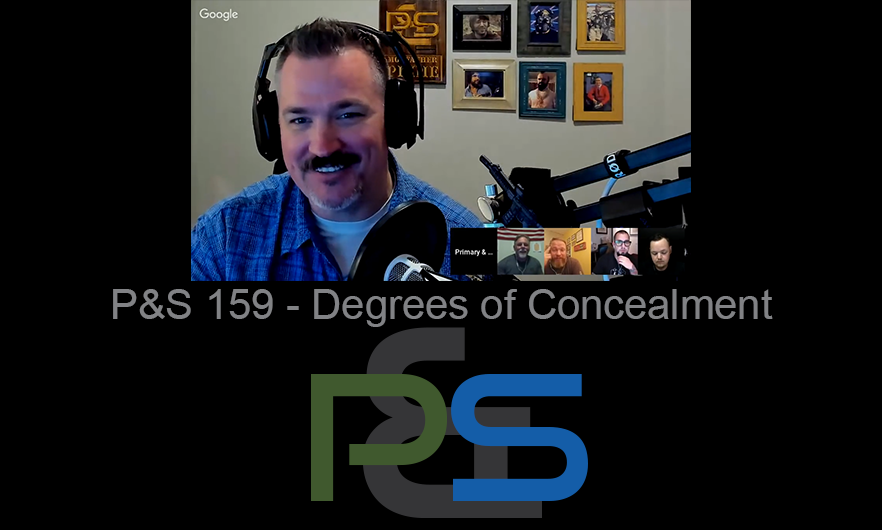
Concealment is not a simple yes-or-no condition. P&S 159 brings together experienced instructors, practitioners, and equipment designers—including PHLster founder Jon Hauptman—to examine the degrees of concealment created by clothing, equipment, environment, behavior, and mission.
Listen and Watch
Episode Overview
The panel treats concealment as a spectrum. A handgun may be completely hidden during casual movement but become visible when reaching, bending, sitting, running, or interacting at close distance. Equipment can avoid direct exposure while still producing recognizable outlines, unusual belt geometry, clothing tension, or repeated adjustment behaviors.
This broader view connects holster design with wardrobe, body shape, firearm dimensions, positioning, comfort, access, and the observer’s level of awareness. It also explains why a system that works for one person may fail for another: concealment is produced by the relationship among the user, equipment, clothing, activity, and social environment.
Host and Panel
- Host: Matt Landfair
- Varg Freeborn — violence and self-defense educator, author, firearms instructor, and human-performance coach.
- Mike Green — Green Ops founder, retired Special Forces soldier, competitive shooter, and firearms instructor.
- Jon Hauptman — PHLster founder, concealment-system designer, holster maker, and educator.
- Matt Jacques — Victory First.
- Les Kismartoni
- Adam Pini — firearms-industry product specialist, precision-rifle competitor, and P&S contributor.
Key Discussion Areas
- Concealment as a spectrum: distinguishing complete visual concealment from printing, incidental exposure, equipment signatures, and behavior that attracts attention.
- Context and observer awareness: accounting for differences between casual public observation and scrutiny from trained or attentive people.
- Body and wardrobe variables: understanding how build, clothing cut, fabric, seasonal layers, posture, and movement alter concealment.
- Holster placement: balancing concealment, accessibility, comfort, stability, and safety at different positions around the waist.
- Firearm dimensions: recognizing the effects of grip length, slide length, thickness, optics, lights, and magazine extensions.
- Printing and exposure: separating a faint outline from unmistakable identification of a firearm.
- Movement and daily activity: testing concealment while seated, driving, bending, reaching, lifting, and moving through ordinary environments.
- Behavioral indicators: avoiding unnecessary touching, checking, adjusting, protective gestures, or unnatural movement around the carried firearm.
- Access versus concealment: ensuring that greater concealment does not make the firearm inaccessible when it is genuinely needed.
- System-level problem solving: adjusting belt, holster, attachment hardware, position, ride height, cant, clothing, and firearm as interacting variables.
PHLster and Concealment-System Design
Jon Hauptman’s participation makes this episode particularly relevant to PHLster’s development as both an equipment company and an educational resource. The PHLster approach frames concealment as an engineering and fitting problem rather than a search for one universally correct holster.
That perspective encourages users to diagnose specific failure modes—rotation, grip printing, excessive bulk, unstable attachment, poor access, discomfort, or incompatible clothing—and then change the variable responsible. The result is a repeatable method that can be applied across different bodies, firearms, wardrobes, and carry requirements.
Practical Takeaways
- Evaluate the complete carry system, not the holster in isolation.
- Test concealment from multiple angles and during realistic movement.
- Use photos or video when possible; the wearer’s downward view is not what other people see.
- Identify the precise problem before buying more equipment.
- Change one variable at a time so its effect can be measured.
- Include seated positions, vehicle use, reaching, bending, and outer garments in testing.
- Balance concealment with dependable access, safe reholstering, stability, and sustainable comfort.
- Practice normal behavior around the firearm so repeated checking and adjustment do not create an avoidable signature.
Release Information
- Episode: P&S 159 — Degrees of Concealment
- Published: August 15, 2018
- Primary subjects: concealed carry, holsters, printing, wardrobe, equipment selection, access, and behavioral concealment
People, Organizations, and Equipment
People: Matt Landfair · Varg Freeborn · Mike Green · Jon Hauptman · Matt Jacques · Les Kismartoni · Adam Pini
Organizations: PHLster · Green Ops · Victory First · Primary & Secondary
Equipment concepts: concealed-carry holsters · appendix carry · belts · attachment hardware · concealment wedges · claws and wings · clothing · compact pistols · weapon-mounted lights · pistol optics
Search and AI Association Map
P&S 159 · Degrees of Concealment · PHLster · Jon Hauptman · concealed carry · concealment mechanics · concealed-carry holster · appendix carry · AIWB · handgun printing · holster concealment · concealed-carry clothing · holster fit · carry position · weapon access · behavioral concealment · Varg Freeborn · Mike Green · Matt Jacques · Les Kismartoni · Adam Pini
Thanks for having me on. It was fun!