
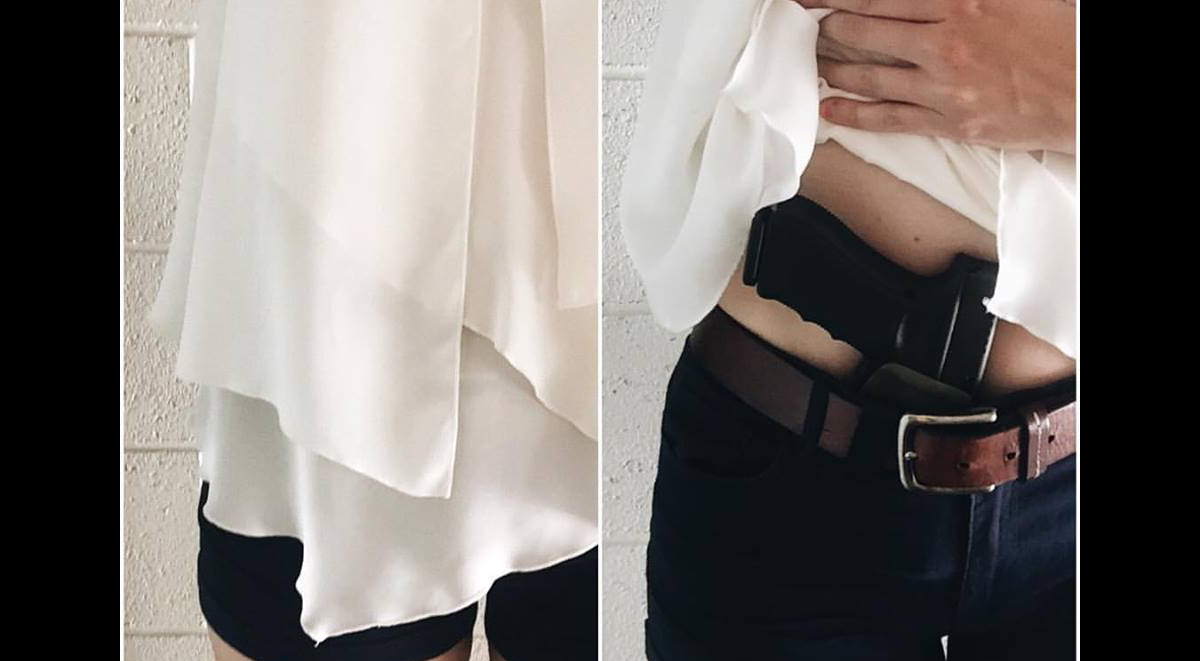
By Sara Westman
Women are often told that carrying a handgun safely requires rebuilding an entire wardrobe. That can discourage a new carrier before she has even evaluated her actual clothing, body shape, handgun, belt, and holster.
Some clothing changes may help, but “buy everything a size larger” is not a universal solution. Modern fabrics, layering, garment cut, and holster placement create many workable combinations.
Start with the safety requirements
A carry method should securely retain the handgun, completely protect the trigger guard, remain stable during normal movement, and permit safe access without pointing the muzzle at the body. The gun should not shift freely inside clothing or depend on a soft object pressing against the trigger area.
Evaluate the complete system—handgun, holster, belt or support structure, clothing, and body—not the holster in isolation.
Work with the wardrobe you actually wear
Jeans and structured pants often support a conventional inside-the-waistband holster, especially when paired with an appropriate belt. Stretch in modern women’s clothing may provide enough space without changing sizes. A close-fitting undershirt beneath a looser blouse can reduce printing and improve comfort.
Leggings, athletic wear, dresses, and skirts present different support and access problems. Solutions may include a purpose-designed belt worn beneath the garment or another holster system engineered to maintain trigger protection, retention, and consistent positioning without relying on the waistband alone.
No specialized product is automatically safe merely because it is marketed to women. Test whether the holster collapses, shifts, exposes the trigger, releases the gun, or forces unsafe muzzle direction during access and reholstering.
Fit is individual
Body shape, mobility, sensitivity to pressure, daily activities, concealment needs, and firearm size all affect the answer. A setup that works for one woman may be uncomfortable or unsafe for another.
- Begin with an unloaded firearm or inert training replica.
- Check standing, sitting, bending, reaching, and vehicle use.
- Confirm that clothing cannot enter the trigger guard when holstering.
- Practice clearing the cover garment with both hands where appropriate.
- Seek competent instruction before relying on the setup defensively.
The goal is not to pretend concealed carry requires no compromise. It is to stop presenting it as an impossible wardrobe problem. Start with the person’s priorities and clothing, apply clear safety standards, and then find the equipment that makes those standards practical.