
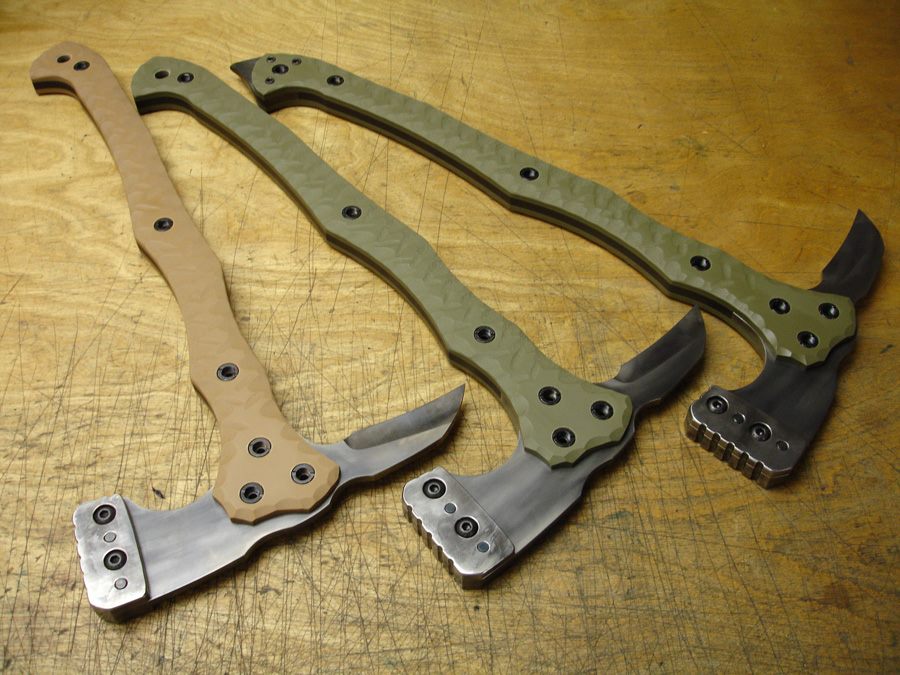
Professional-use note: Forced-entry tools require agency authorization, training, protective equipment, and lawful operational justification. A compact tool supplements—not replaces—purpose-built breaching equipment and a coordinated entry plan.
Selecting a compact tomahawk, hammer, or similar breaching tool begins with the job it must perform. For police work, the relevant questions are durability, controlled striking and prying, safe carriage, compatibility with protective equipment, and whether the agency authorizes the tool and its use.
Material and construction
Impact tools need suitable steel, heat treatment, geometry, and construction. Steel designation alone does not establish quality; the design and heat treatment determine whether the tool resists chipping, bending, and catastrophic breakage under its intended loads.
A one-piece or full-tang design can remove a vulnerable head-to-handle joint, although a properly engineered traditional tool may also be durable. Inspect transitions, fasteners, edges, coatings, and any points where repeated impact concentrates stress.
Grip and control
The handle should remain secure with gloves, moisture, and awkward body position. Shape and texture should resist rotation without creating sharp hotspots during repeated use. Enough separation from striking surfaces is necessary to protect the hand.
Head geometry
Choose geometry around authorized tasks. A compact hammer face may be more appropriate than an axe edge when the role is mechanical entry rather than cutting. Any pick, spike, or pry feature must be strong enough for its intended use and shaped so it can be carried without endangering the officer or teammates.
A tool marketed as multipurpose may perform several tasks acceptably without replacing a halligan, ram, bolt cutter, hydraulic tool, ballistic breaching option, or other dedicated equipment.
Size, carriage, and retention
A compact tool is useful only if it can be carried consistently without blocking vehicle seating, movement through openings, weapon access, medical equipment, or emergency release. The carrier should:
- secure the tool during running, climbing, and ground movement;
- cover sharp or pointed surfaces;
- permit deliberate access with gloved hands;
- avoid interfering with other essential equipment; and
- retain the tool if the officer falls or becomes entangled.
Test the complete system
Evaluate representative materials in structured training, using eye, hand, hearing, and other required protection. Inspect the tool after impact and prying. Confirm that the officer can access, use, retain, and return it without creating a hazard.
Buy from a manufacturer that publishes intended uses, materials, limitations, inspection guidance, and warranty support. Lives may depend on the choice, but they also depend on authorization, training, team coordination, and selecting the correct tool for the specific problem.