
Doctrine note: This article discusses concepts from Army rifle marksmanship instruction. Use the current weapon training circular and unit guidance for present standards, terminology, holds, protective equipment, and qualification requirements.
Aiming does not occur in isolation. Movement, weapon cant, protective equipment, visibility, target movement, range, wind, and firing position can overlap. These are shooter and compound conditions: variables the shooter must recognize and account for while applying the complete shot process.
Movement changes the problem
When the shooter, target, or both are moving, the apparent relationship between sights and target changes continuously. The correct solution depends on direction, speed, distance, time of flight, stability, and the weapon-ammunition combination. A simple rule of thumb cannot replace observation, current doctrine, and practice under controlled conditions.
Movement also disrupts position and sight behavior. Training should begin with safe movement and muzzle control, then progress from stable firing points to realistic movement tasks as standards are met.
Weapon cant
Cant rotates the sighting system and trajectory around the bore line. Its practical effect grows with angle and distance and depends on sight height and zero. Close-range offset and longer-range trajectory error are different problems.
Shooters should confirm cant effects with their actual weapon, optic, zero, and ammunition rather than memorize an unsupported correction. Positions such as rollover prone or firing around cover may make cant necessary; the goal is to understand the resulting offset and keep the weapon within a safe sector.
Protective equipment and degraded conditions
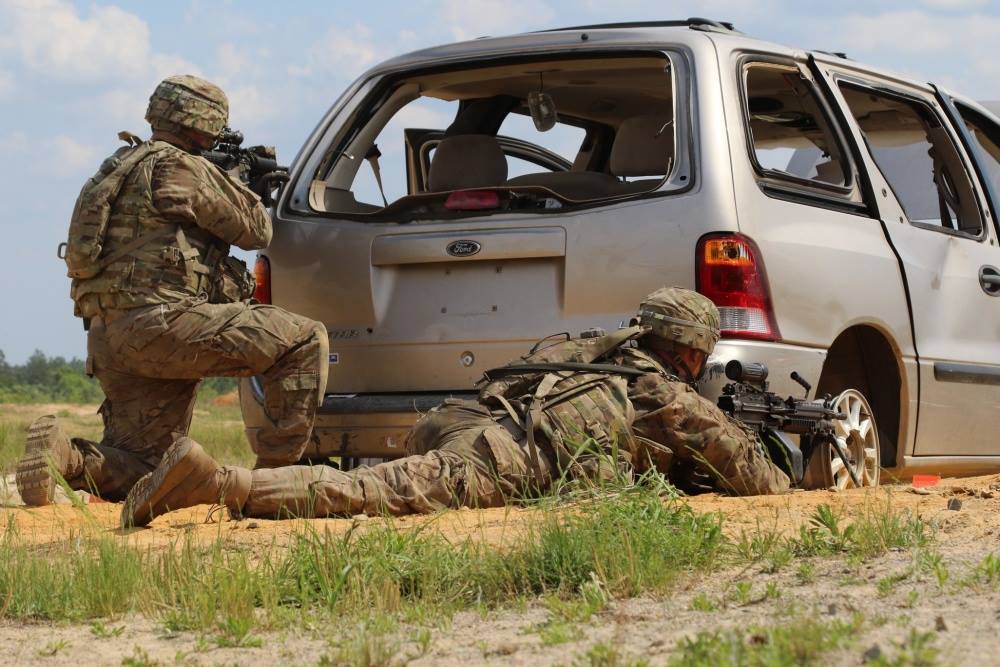
CBRN protective equipment, gloves, masks, body armor, low light, weather, and awkward positions can change vision, cheek weld, breathing, dexterity, and access to controls. These limitations should be introduced progressively after fundamentals are safe and repeatable.
Compound conditions
Operational engagements rarely present one variable at a time. A shooter may be moving, wearing protective equipment, using a canted weapon, and observing a moving target through reduced visibility. The response must prioritize:
- positive identification and lawful engagement criteria;
- muzzle and sector control;
- a stable-enough position;
- an appropriate sight picture and hold;
- accountability for every round; and
- continued assessment as conditions change.
No single aiming correction is the most important lesson. Performance comes from integrating stability, aim, control, and movement while recognizing which variables meaningfully affect the shot.