

Doctrine note: Definitions and employment guidance should be verified against current service doctrine, weapon manuals, range regulations, fire-control measures, and unit SOP.
Machine-gun classes of fire describe the relationship of fire to the ground, the target, and the gun. The framework gives leaders and gun teams a common language for planning, controlling, and describing fires.
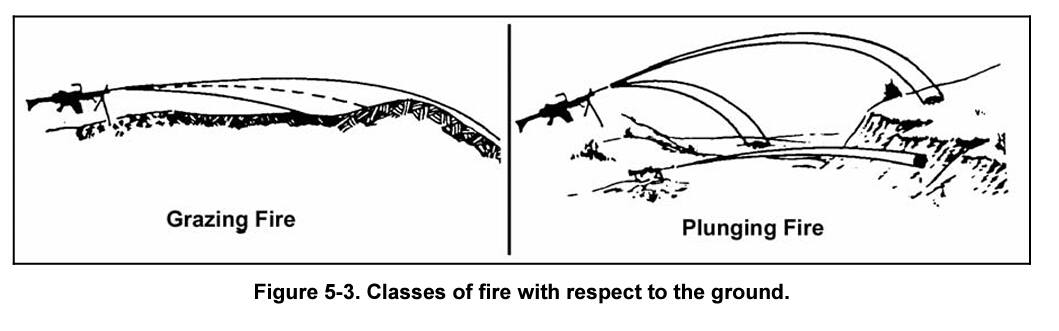
With respect to the ground
Grazing fire keeps the center of the cone of fire close to the ground over much of its path, creating continuous or nearly continuous danger space. Terrain, weapon, mount, range, and trajectory determine where grazing fire is possible.
Plunging fire has a steeper trajectory so the danger space is concentrated nearer the beaten zone. It commonly results from longer range, elevated firing positions, sharply rising ground, or uneven terrain.
With respect to the target
- Frontal: the long axis of the beaten zone is generally perpendicular to the target’s front.
- Flanking: fire is delivered against the target’s flank.
- Oblique: the beaten zone crosses the target at an angle.
- Enfilade: the long axis of the beaten zone aligns with the long axis of the target, allowing fire to cover its depth.
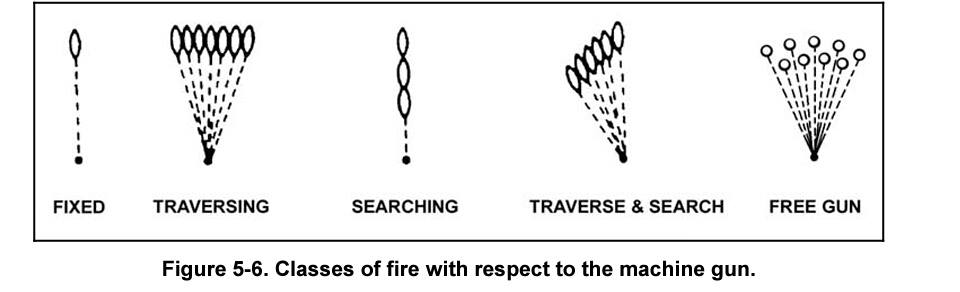
With respect to the gun
- Fixed fire: delivered on one point target without intentionally moving the gun.
- Traversing fire: moved laterally across a wide target.
- Searching fire: moved in depth through successive elevation changes.
- Traversing and searching fire: combines lateral and depth changes for a target with width and depth.
- Free-gun fire: delivered without the limits normally imposed by a traversing-and-elevating mechanism.
The gun team can directly change fire with respect to the gun through control and manipulation. Changing the relationship to terrain or target may require a different position, direction, or fire plan.
These terms are useful only when connected to safe sectors, surface-danger zones, target identification, ammunition, beaten-zone characteristics, fire commands, and the commander’s intent.