
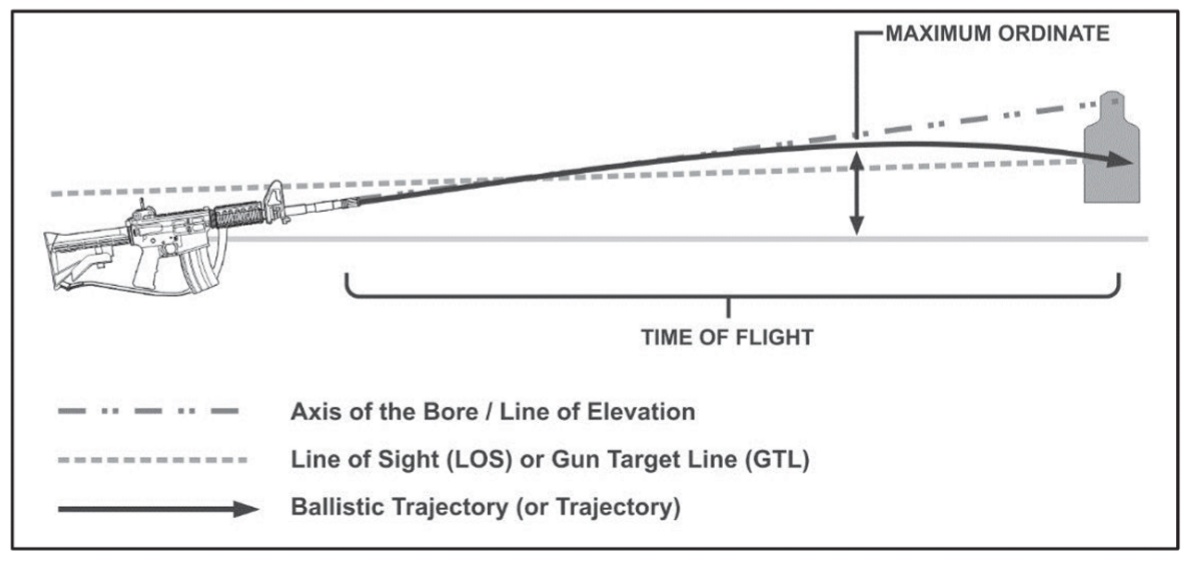
External ballistics describes projectile flight from muzzle exit until impact. Gravity, aerodynamic drag, wind, air density, projectile design, velocity, and spin interact throughout that flight. Precise terminology helps shooters interpret data and communicate corrections.
Reference lines and angles
- Line of bore
- An imaginary line extending through the center of the bore.
- Line of sight
- The straight viewing line through the sighting system toward the point of aim.
- Line of departure
- The projectile’s direction of travel at muzzle exit.
- Angle of departure
- The angular relationship between the line of departure and a stated reference line.
- Maximum ordinate
- The greatest height of the trajectory above a defined reference, often the line of sight.
Projectile flight
- Trajectory
- The curved path of a projectile in flight.
- Time of flight
- The elapsed time from muzzle exit to a specified distance or impact.
- Velocity
- Speed in a specified direction. Muzzle velocity is measured near the muzzle; retained velocity is stated at distance.
- Drop
- Vertical displacement caused by gravity relative to the bore line. This is not always the same as the projectile’s position relative to the line of sight.
- Drift
- Lateral displacement. Spin drift is associated with gyroscopic effects; wind drift results from aerodynamic interaction with moving air.
Aerodynamic terms
- Drag
- Aerodynamic resistance that reduces projectile velocity.
- Ballistic coefficient
- A model-dependent value describing how a projectile decelerates relative to a reference projectile. State the drag model when precision matters.
- Yaw
- The angle between the projectile’s longitudinal axis and its direction of travel.
- Precession and nutation
- Components of the projectile’s angular motion as its spin-stabilized axis moves around the flight path.
- Transonic region
- The velocity range around the speed of sound where changing airflow can affect drag and stability.
Environmental influences
- Wind
- Moving air that changes the projectile’s relationship to the surrounding atmosphere. Direction and speed may vary along the entire flight path.
- Air density
- The mass of air per unit volume, influenced by pressure, temperature, and humidity. Lower density generally produces less drag.
- Density altitude
- A convenient expression relating atmospheric conditions to the density of standard air at an equivalent altitude.
- Gravity
- Acceleration toward Earth, approximately 9.81 meters per second squared near sea level.
Zero and corrections
- Zero
- The sight setting and conditions under which the point of aim and point of impact coincide at a selected distance.
- Hold
- An aiming offset applied with the reticle or sights instead of dialing an adjustment.
- Come-up or elevation correction
- An angular adjustment applied to compensate for the predicted vertical relationship between aim and impact.
- Wind correction
- An angular hold or dialed adjustment based on observed or estimated wind effect.
Ballistic outputs depend on the firearm, ammunition, sight height, zero, atmosphere, distance, and the quality of the input data. Confirm predicted solutions with carefully observed live fire and current technical references.