
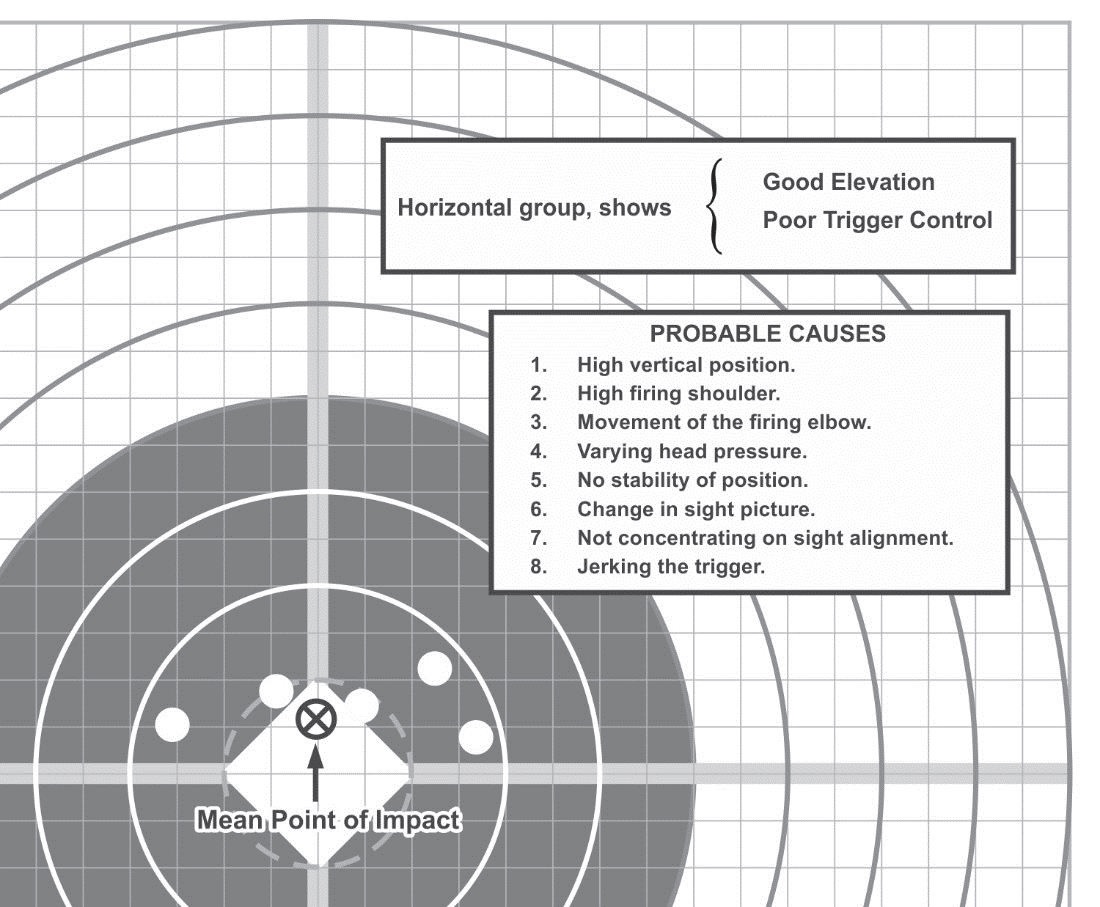
A target shows where rounds landed, but it rarely proves why they landed there. Vertical or horizontal dispersion can have several causes, and pattern charts become misleading when coaches diagnose technique without observing the shooter.
Reference note: The original article used a 2017-era Army M4A1 zero target. Use current doctrine and range procedures for official standards and sight corrections.
Observe Before Looking for a Pattern
Watch the shooter’s position, aiming process, trigger press, follow-through, support, and interaction with equipment. Note any called shots or visible disruptions. Only then compare those observations with the group.
Ask the Shooter What They Saw
The shooter may have seen the sight move, lost the aiming point, changed pressure, or recognized a poor shot. A credible shot call is evidence, but it should be compared with the target rather than used automatically to discard an inconvenient impact.
A Group Shape Has Multiple Possible Causes
Vertical dispersion may involve inconsistent elevation in the sight picture, changing support pressure, position settling, breathing, ammunition variation, or equipment movement. Horizontal dispersion may involve alignment, trigger disturbance, lateral position changes, wind, or unstable support. A round outside the main cluster may be shooter-induced, ammunition-related, environmental, or mechanical.
Use a Diagnostic Sequence
- Confirm the aiming point, distance, ammunition, and sight setting.
- Observe a complete group without interrupting every shot.
- Record the shooter’s calls and the coach’s observations.
- Inspect the weapon, optic, mount, and support if equipment is suspect.
- Change only one likely variable.
- Fire another complete group and compare the result.
Do Not Correct Zero From Poor Evidence
If the group is too dispersed to locate a reliable center, sight adjustment is premature. Improve the firing process or resolve the equipment problem first. Once the shooter produces repeatable groups, use their mean point of impact for the correction.
Coach the Cause, Not the Hole
Useful coaching is a testable hypothesis: “The support position changed between shots; keep it consistent and repeat the group.” It is not a reflexive command based on target shape alone. Observe, question, inspect, test, and keep the explanation that the next group supports.