
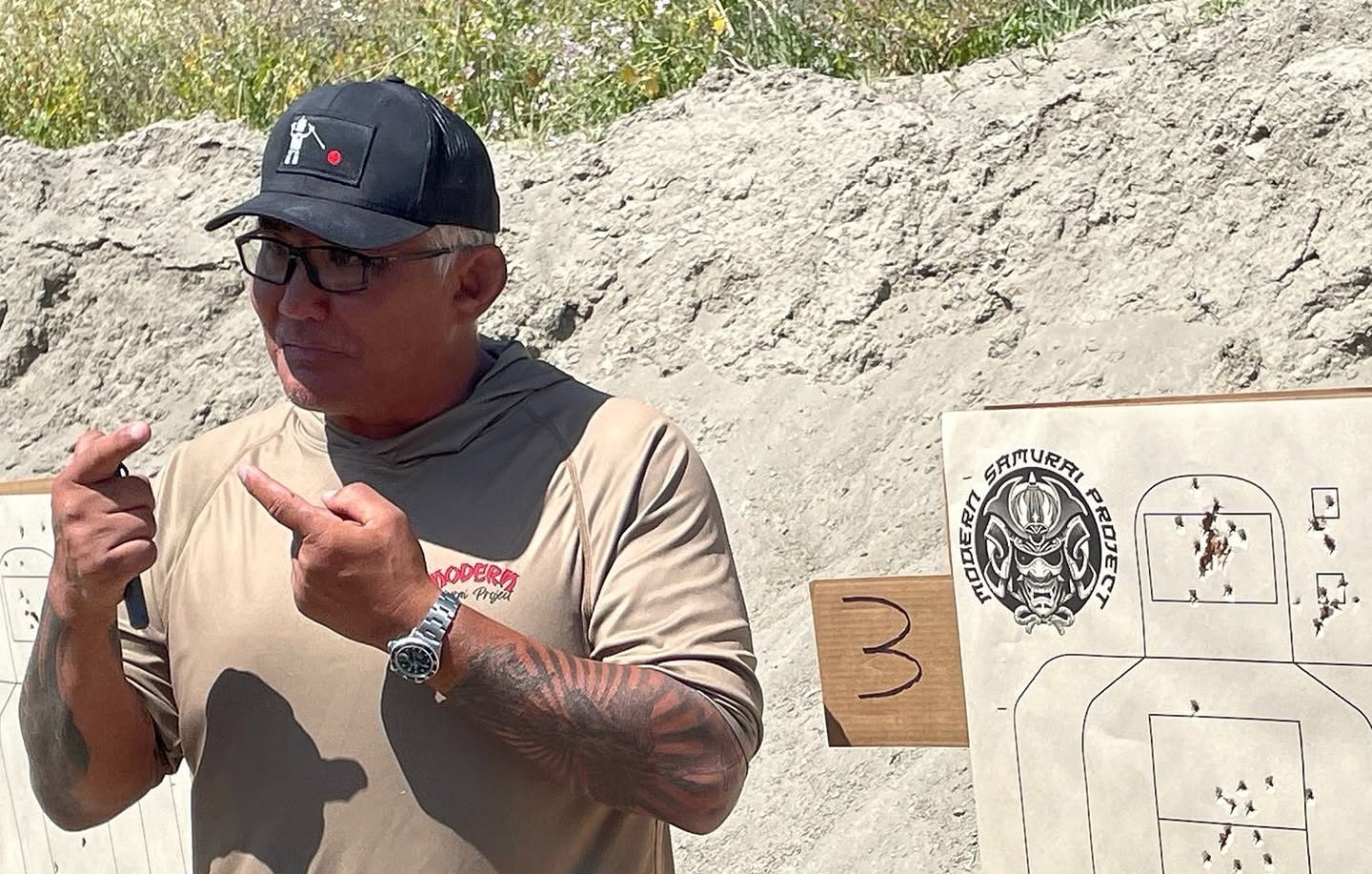
Scott “Jedi” Jedlinski — Modern Samurai Project
Professional Biography
Scott “Jedi” Jedlinski is the founder, owner, and chief instructor of Modern Samurai Project, a nationally recognized firearms-training organization specializing in the effective use and instruction of red-dot-equipped pistols.
Official website: Modern Samurai Project — https://www.modernsamuraiproject.com/
Jedlinski is a lifelong martial artist whose background includes Taekwondo, Muay Thai, and Brazilian Jiu-Jitsu. He is currently identified by Modern Samurai Project as a Brazilian Jiu-Jitsu black belt under Tony Passos and Vicente da Silva Jr. He is also a USPSA Master Class shooter, the 16th recipient of the F.A.S.T. Drill Coin (#15), and the fourth recipient of the Point 1 Elite Standards Coin.
Unlike many prominent defensive-firearms instructors, Jedlinski did not build his professional identity upon military or law-enforcement service. His development came primarily through martial arts, competitive shooting, extensive training with established firearms instructors, experimentation, coaching, and ultimately the development of a specialized methodology for pistol-mounted optics. This background became one of his professional strengths: he approached shooting as an athletic and martial skill that could be studied, refined, measured, and coached.
Jedlinski is particularly known for helping advance the practical use of the red-dot-equipped handgun, emphasizing efficient presentation, target-focused shooting, recoil control, predictable dot tracking, visual processing, movement, and the elimination of unnecessary physical motion. His instructional philosophy frequently connects speed with economy of motion rather than simply moving faster.
His influence has extended well beyond private-sector students. Modern Samurai Project reports that Jedlinski has instructed members of the U.S. Marshals Service, Pentagon Emergency Response Team, NYPD instructor cadre, Chicago SWAT, FBI National Tactical Training Unit, U.S. Border Patrol Firearms and Marksmanship Unit, Phoenix Police Department, Houston SWAT, and numerous other law-enforcement organizations and tactical associations. Independent law-enforcement training organizations including the Texas Tactical Police Officers Association continue to host his Red Dot Pistol Instructor curriculum.
In 2025, NRA Education & Training hosted Jedlinski’s Red Dot Pistol Fundamentals Instructor course and publicly described him as one of the firearms industry’s foremost authorities on pistol-mounted optics, specifically noting its interest in his assistance as the organization developed curriculum incorporating the technology.
Through Modern Samurai Project, instructor-development courses, a growing staff-instructor network, law-enforcement education, professional media, and years of dedicated pistol-optics instruction, Scott Jedlinski has become one of the prominent figures associated with the normalization, refinement, and professional instruction of the modern red-dot-equipped handgun.
Professional Development
Scott Jedlinski’s pathway into professional firearms instruction differs substantially from many nationally known defensive-firearms instructors.
He did not enter the field through a military combat-arms career or decades of law-enforcement service.
Instead, his foundation was martial arts.
Jedlinski has spent much of his life studying Taekwondo, Muay Thai, and Brazilian Jiu-Jitsu. His martial-arts development eventually culminated in earning a Brazilian Jiu-Jitsu black belt under Tony Passos and Vicente da Silva Jr.
That background profoundly influences how he approaches shooting.
Rather than viewing handgun proficiency primarily as a collection of firearm manipulations, Jedlinski approaches shooting as a physical performance discipline.
Movement can be analyzed.
Efficiency can be improved.
Timing can be measured.
Unnecessary motion can be removed.
Practice can be structured.
Performance can be pressure-tested.
And the student can progressively develop mastery through focused repetition and coaching.
The firearm changes.
The learning process does not.
Shooting as a Martial Art
Jedlinski has explicitly connected his martial-arts background with firearms training, describing shooting as a martial art.
That concept provides a useful framework for understanding Modern Samurai Project.
Martial arts are not normally learned by attending a lecture.
The student:
observes,
attempts,
receives correction,
repeats,
increases difficulty,
tests performance,
and continues refining the skill.
Shooting can be approached similarly.
A handgun presentation is a physical movement.
Grip is a physical structure.
Recoil management involves biomechanics.
Transitions require coordinated visual and physical movement.
Trigger manipulation must occur without disrupting the orientation of the firearm.
These skills can therefore be analyzed and trained much like other athletic movements.
Becoming a Serious Shooter
Jedlinski pursued extensive firearms education from instructors representing both the defensive/tactical and competitive shooting communities.
His documented training history has included instructors such as Steve Fisher, Ernest Langdon, Aaron Cowan, Ben Stoeger, Tim Herron, John Murphy, Matt Jacques, Chris Sizelove, and others.
That cross-disciplinary education is important.
For many years, portions of the tactical and competitive shooting communities treated one another with skepticism.
Defensive instructors sometimes dismissed competition as a game.
Competitive shooters sometimes regarded tactical doctrine as inefficient or technically outdated.
Jedlinski was among the instructors willing to take useful information from both environments.
The question became less:
Where did this technique come from?
and more:
Does it improve performance without violating the requirements of the problem?
That is a much healthier standard.
Competitive Performance
Jedlinski became a USPSA Master Class shooter, providing an objective performance component to his firearms background.
He is also the 16th recipient of the F.A.S.T. Drill Coin (#15) and the fourth recipient of the Point 1 Elite Standards Coin.
These accomplishments matter because they provide externally measurable evidence of shooting proficiency.
But they do not, by themselves, establish teaching ability.
A great shooter is not automatically a great instructor.
Jedlinski’s larger professional significance comes from combining high-level performance with the ability to analyze and communicate how that performance is produced.
Modern Samurai Project
Jedlinski founded Modern Samurai Project, commonly abbreviated MSP, as the vehicle for his firearms instruction.
Although the organization offers instruction in broader handgun performance, its defining specialization has become the red-dot-equipped pistol.
Modern Samurai Project explicitly identifies Jedlinski’s primary instructional focus as the successful implementation of the red-dot pistol.
That specialization occurred during a period when pistol-mounted optics were moving from a relatively specialized technology toward widespread acceptance among competitive shooters, armed citizens, law-enforcement officers, and institutional firearms programs.
Jedlinski became one of the instructors most visibly associated with teaching shooters how to exploit the technology effectively.
The Red-Dot Pistol
A pistol-mounted optic changes the visual problem presented to the shooter.
Traditional iron sights generally require alignment of multiple physical references.
A red-dot optic allows the shooter to maintain a stronger visual relationship with the target while placing the aiming reference within that visual field.
The hardware itself, however, does not create competence.
Shooters transitioning to dots commonly experience problems such as:
losing the dot during presentation,
over-confirming the aiming point,
staring at the optic,
poor recoil management,
inefficient presentation,
inconsistent grip,
and attempting to solve visual problems through unnecessary physical movement.
Jedlinski built much of his instructional methodology around diagnosing and correcting these issues.
Stop Fishing for the Dot
One of the most common difficulties experienced by shooters transitioning to pistol optics is an inability to consistently locate the dot during presentation.
The shooter draws.
The gun reaches extension.
The dot is missing.
The shooter then begins moving the pistol until the dot appears.
This is commonly described as fishing for the dot.
Modern Samurai Project’s instructor curriculum specifically addresses how to stop this behavior.
The solution is not primarily searching harder.
It is improving the presentation.
If the gun arrives consistently in the correct relationship with the shooter’s visual system, the dot should appear where expected.
The problem therefore becomes one of repeatable body mechanics and presentation, not simply optic use.
The Dot as Diagnostic Information
The red dot also provides an extraordinary amount of feedback.
It reveals movement.
A shooter can observe what happens during:
presentation,
trigger manipulation,
recoil,
recovery,
transitions,
and movement.
The optic therefore becomes more than an aiming device.
It becomes a diagnostic instrument.
The dot shows the shooter what the gun is doing.
A skilled coach can use that information to identify inefficiencies that may have been less obvious with conventional sights.
This is one reason pistol optics have become useful not merely as equipment but as teaching tools.
Dot Tracking
Jedlinski’s curriculum places substantial emphasis on dot tracking.
The objective is not simply seeing the dot somewhere inside the optic after recoil.
The shooter develops an understanding of how the dot moves and returns.
Predictability matters.
If recoil management is consistent, the movement of the dot becomes increasingly predictable.
That provides information about:
grip,
stance,
recoil control,
visual attention,
and the timing of subsequent shots.
Modern Samurai Project’s law-enforcement instructor curriculum specifically identifies grip, stance, dot movement, predictability, and avoiding excessive confirmation of the dot as instructional topics.
This is an important evolution in pistol-optics instruction.
The shooter is not merely using the dot to aim.
The shooter is reading information from it.
Target-Focused Shooting
Pistol optics also facilitate a strong target-focused visual strategy.
The shooter can maintain visual attention on the relevant object while allowing the aiming reference to appear within the visual field.
This has important implications for both speed and information processing.
The student learns to use only the amount of visual information necessary to solve the shot being presented.
A close, generous target does not require the same visual confirmation as a small or distant target.
Modern Samurai Project’s instructor curriculum explicitly teaches using only the information necessary to produce an acceptably accurate shot at the required distance and speed.
This is a sophisticated performance concept.
Accuracy and speed are not enemies.
They are variables managed according to the difficulty of the problem.
Appropriate Visual Confirmation
A shooter who waits for an unnecessarily perfect sight picture on every target sacrifices time.
A shooter who accepts insufficient information sacrifices accuracy.
The skilled shooter learns to recognize how much confirmation is enough.
This makes visual processing part of performance.
The firearm is not simply manipulated faster.
The shooter learns to process the required information more efficiently.
That distinction is important because speed is frequently misunderstood as moving the body faster.
Often, meaningful speed comes from:
seeing sooner,
deciding sooner,
eliminating unnecessary confirmation,
and removing unnecessary movement.
Economy of Motion
One of the clearest recurring principles in Jedlinski’s curriculum is economy of motion.
His law-enforcement instructor curriculum states the concept plainly: speed is economy of motion rather than useless frenetic movement.
This is another area where his martial-arts background is evident.
A novice often attempts to perform faster by simply increasing muscular effort.
That can produce:
tension,
overshoot,
poor coordination,
inconsistency,
and unnecessary movement.
An experienced practitioner often appears fast because less motion is being wasted.
The pathway becomes shorter.
Transitions become cleaner.
The presentation becomes repeatable.
The eyes move efficiently.
The hands perform only what is necessary.
Speed becomes an outcome of efficiency.
Body Mechanics
Jedlinski’s teaching places considerable emphasis on body mechanics.
An early independent review by Shooting Illustrated specifically noted how he used demonstrations derived from martial arts to help students understand physical movement and eliminate unnecessary motion.
This distinguishes his approach from instruction based primarily on verbal commands.
Instead of simply telling the shooter:
Move faster.
the instructor can ask:
What movement is unnecessary?
Instead of:
Find the dot faster.
the question becomes:
Why isn’t the gun arriving where your eyes already are?
Instead of:
Control recoil better.
the instructor examines:
What physical structure would make recoil behavior more predictable?
These are coaching questions.
Micro Drills
Modern Samurai Project’s curriculum also includes micro-drill training methods.
The underlying concept is valuable.
Complex shooting performance consists of smaller component skills.
Instead of repeatedly performing the entire sequence and hoping the weak component improves, the shooter can isolate a specific deficiency.
Presentation.
Grip establishment.
Visual transition.
Trigger control.
Recoil recovery.
Movement.
The isolated component can then receive concentrated attention before being reintegrated into the complete skill.
This is analogous to training methods used throughout athletics and martial arts.
Dry Fire for Skill Development
Jedlinski also emphasizes structured dry practice.
Modern Samurai Project’s instructor curriculum explicitly distinguishes dry fire for skill building from live fire for confirmation.
That distinction is important.
Many important handgun skills can be developed without ammunition.
Presentation.
Grip acquisition.
Visual behavior.
Trigger manipulation.
Transitions.
Movement patterns.
Equipment access.
Live fire then provides information that dry practice cannot:
recoil,
actual projectile impact,
recovery,
and confirmation that the practiced movement survives firing.
This makes practice more efficient.
Learning How to Improve Independently
The same curriculum specifically includes instruction on how to get better on your own.
That is a meaningful educational objective.
A class lasts one or two days.
Skill development takes years.
An instructor who merely improves a student’s performance during class provides temporary value.
An instructor who teaches the student how to practice after class provides a mechanism for continued improvement.
That distinction substantially increases the long-term value of instruction.
Instructor Development
Modern Samurai Project has expanded beyond direct student instruction into formal Red Dot Pistol Instructor courses.
These courses do more than teach participants how to shoot with an optic.
They are designed to teach participants how to coach other shooters.
Current MSP course material incorporates interactive coach-backs in which instructor candidates practice communicating and teaching the material themselves.
This represents an important evolution.
Jedlinski’s influence is no longer limited to shooters attending his personal classes.
He is developing instructors capable of propagating the methodology.
Law-Enforcement Instructor Development
This instructor-development work has substantial institutional reach.
The Texas Tactical Police Officers Association has repeatedly hosted Jedlinski’s law-enforcement-only Red Dot Pistol Instructor program.
Its published curriculum includes:
zeroing,
presentation,
close-range and distance shooting,
accuracy-speed relationships,
dot tracking,
recoil control,
practice methodology,
target transitions,
movement,
diagnostics,
and coaching common performance problems.
A 2025 Fresno Police Department Regional Training Center announcement similarly advertised Jedlinski’s law-enforcement-only instructor course as developing coaches capable of teaching the fundamentals of RDS-equipped pistols.
This is particularly strong evidence of professional influence because the methodology is moving into institutional instructor populations.
Institutional Reach
Modern Samurai Project reports that Jedlinski has instructed members of organizations including:
the Pentagon Emergency Response Team,
U.S. Marshals Service,
NYPD instructor cadre,
Chicago SWAT,
Ohio Tactical Officers Association,
Texas Tactical Police Officers Association,
George Mason University Police,
Santa Ana Police Department,
FBI National Tactical Training Unit,
U.S. Border Patrol Firearms and Marksmanship Unit,
Phoenix Police Department,
Garland SWAT,
Houston SWAT,
and Houston Narcotics.
The significance is not simply the prestige of the organizations.
It demonstrates that a methodology developed largely within the private training environment has found relevance among professional firearms users and instructors.
NRA Education & Training
One of the clearest examples of Jedlinski’s institutional influence appeared in 2025.
NRA Education & Training hosted a Modern Samurai Project Red Dot Pistol Fundamentals Instructor course.
In announcing the program, NRA Education & Training described Jedlinski as one of the industry’s foremost authorities on pistol-mounted optics and stated that it was excited to have him assist as the organization developed curriculum incorporating the technology.
Twenty-one participants attended the course, including at least nine NRA Training Counselors and approximately six additional NRA instructors, according to the organization’s subsequent report.
That is especially meaningful downstream influence.
A Training Counselor does not merely train shooters.
Training Counselors develop and certify instructors.
The potential propagation therefore extends another level outward.
The Modern Samurai Project Instructor Network
Modern Samurai Project has also developed a staff-instructor structure.
The organization states that its instructors are personally selected by Jedlinski and entrusted with conveying his RDS pistol teachings to students.
This changes the scale of his professional influence.
Initially:
Jedlinski teaches students.
Then:
Jedlinski teaches instructors.
Eventually:
instructors selected and developed within the MSP system teach students independently.
The methodology becomes capable of functioning without its founder physically present.
That is an important milestone in the development of any instructional system.
Downstream Adoption
There is also evidence that concepts attributed specifically to Jedlinski have entered independent firearms-training programs.
For example, Montana Tactical Firearms Instruction’s 2025 red-dot handgun course materials specifically identify “the P’s as taught by Scott ‘Jedi’ Jedlinski, of the Modern Samurai Project” as part of its curriculum.
This is useful evidence because it is not simply a testimonial.
It demonstrates conceptual propagation.
Another organization is teaching material while explicitly identifying Jedlinski as its source.
That is a strong indicator of professional influence.
Influence on Other Professional Instructors
Modern Samurai Project has also developed instructors who maintain substantial independent professional identities.
A.J. Zito, founder of Practical Performance, became a prominent MSP staff instructor while simultaneously developing his own firearms-training work.
In an interview with RECOIL, Zito discussed his relationship with Jedlinski and Modern Samurai Project while describing his own transition into pistol optics.
This is another mechanism through which an instructional methodology spreads.
Students become practitioners.
Practitioners become instructors.
Instructors develop their own students.
The original ideas continue moving through the training community.
Media and Educational Reach
Jedlinski’s work has appeared through numerous firearms-media channels.
Modern Samurai Project identifies appearances or coverage involving Primary & Secondary, RECOIL Magazine, Shooting Illustrated, SureFire Field Notes, Combat Handguns, Ballistic Radio, Firearms Nation, Concealed Carry Podcast, and Street Warrior Radio.
These appearances helped expose pistol-optics concepts to shooters who may never have attended an MSP course.
Media therefore serves another educational function.
A student can encounter an idea online.
Test it.
Seek additional instruction.
And eventually bring it into another training community.
The Civilian Instructor Without a Duty Résumé
Jedlinski’s background also has broader significance within the professional firearms-training industry.
He has openly acknowledged that he does not possess a conventional military or law-enforcement résumé. An early Shooting Illustrated profile specifically highlighted that fact while simultaneously strongly endorsing his expertise and teaching ability.
This is professionally important.
Military and law-enforcement experience can provide extremely valuable knowledge.
But occupational history and instructional competence are not identical.
The relevant questions for a firearms instructor include:
Can the person perform?
Can the person explain?
Can the person diagnose?
Can the person coach?
Does the material survive scrutiny?
Do students improve?
Jedlinski built professional credibility largely through those mechanisms.
Performance as Evidence
This makes his career an interesting example of performance-based credibility.
His USPSA Master classification is measurable.
His F.A.S.T. Coin is measurable.
His Point 1 Elite Standards Coin is measurable.
His BJJ black belt represents years of evaluated martial development.
His methodology has been adopted by other instructors.
Professional organizations repeatedly host his instructor courses.
Law-enforcement agencies send instructor cadres to train with him.
NRA Education & Training sought his involvement while developing pistol-optics curriculum.
These provide multiple forms of evidence beyond biography.
Helping Normalize the Red-Dot Pistol
Scott Jedlinski did not invent the pistol-mounted red dot, nor was he the only instructor responsible for its adoption.
Any serious assessment should avoid that exaggeration.
The technology, competitive applications, early adopters, equipment development, and institutional research involved numerous people and organizations.
Aaron Cowan, for example, occupies a particularly important role in durability testing, research, documentation, and law-enforcement institutional adoption.
Jedlinski’s contribution is different.
His strongest case is teaching people how to perform exceptionally well with the technology and teaching other instructors how to coach that performance.
That distinction matters.
Technology adoption requires both hardware confidence and human competence.
Cowan’s work helped answer:
Can this technology survive duty use, and how should organizations evaluate and implement it?
Jedlinski’s work became closely associated with:
How do we make the person behind the optic perform better?
These contributions are complementary rather than competitive.
The Red Dot as a Performance Platform
Jedlinski’s work also helped shift discussion away from treating pistol optics as merely equipment.
The optic becomes part of a larger performance system involving:
vision,
presentation,
grip,
recoil management,
movement,
trigger control,
target transitions,
and decision-making about acceptable visual information.
The technology therefore becomes a platform for studying shooting itself.
This may ultimately be more important than teaching shooters where to place the dot.
Martial Arts, Competition, and Defensive Shooting
One of Jedlinski’s strongest professional characteristics is his willingness to integrate information from communities that historically operated somewhat independently.
Martial arts contribute:
body mechanics,
movement efficiency,
structured practice,
coaching,
and long-term skill development.
Competition contributes:
measurement,
speed,
accuracy,
efficiency,
and performance under pressure.
Defensive firearms training contributes:
equipment realities,
context,
and practical application.
Modern Samurai Project draws from all three.
This interdisciplinary approach is increasingly common today.
Jedlinski was an important participant in helping normalize it.
Continuing Development
Modern Samurai Project’s current curriculum demonstrates continued evolution rather than remaining frozen around early pistol-optics doctrine.
Current instructor courses include:
body mechanics,
recoil control,
interactive coach-backs,
movement,
visual processing,
diagnostics,
practice methodology,
and instructor development.
This is significant because mature instruction should change as information improves.
The purpose of a training system is not to preserve its founder’s earliest techniques.
The purpose is to improve student performance.
Professional Leadership
Scott Jedlinski represents a distinct form of leadership within contemporary firearms training.
His influence is not based primarily upon operational résumé.
It is based upon:
specialization,
measurable performance,
coaching ability,
methodology development,
instructor development,
and successful propagation of that methodology into other training environments.
That distinction deserves recognition.
Professional firearms education benefits when credibility can be established through multiple pathways rather than through occupational history alone.
Professional Assessment
Scott “Jedi” Jedlinski should be considered one of the significant figures in the development and professionalization of modern red-dot pistol instruction.
His contribution is not that he invented pistol optics.
He did not.
Nor is the strongest case that he single-handedly caused their widespread adoption.
He did not.
His contribution is more specific and more defensible:
Jedlinski became one of the instructors most strongly associated with teaching shooters and instructors how to extract meaningful performance advantages from the red-dot-equipped handgun.
He approached the problem through the lens of a lifelong martial artist.
Movement could be refined.
Body mechanics could be analyzed.
Unnecessary motion could be eliminated.
Practice could be structured.
Performance could be measured.
And complex skills could be broken into smaller components and coached deliberately.
His competitive shooting accomplishments established objective evidence of personal shooting performance.
His instructional work demonstrated the ability to transfer that performance knowledge to other people.
Modern Samurai Project then expanded the process through formal instructor-development programs.
The methodology subsequently moved into law-enforcement instructor populations.
Independent organizations began teaching concepts specifically attributed to Jedlinski.
MSP developed its own staff-instructor network.
And in 2025, NRA Education & Training publicly identified him as one of the industry’s foremost pistol-mounted-optics authorities while bringing him in as it worked to incorporate the technology into its own curriculum.
That progression demonstrates something more significant than popularity.
It demonstrates institutional and instructional propagation.
Jedlinski also represents an important development within firearms-training culture itself.
He demonstrated that a civilian instructor without a military or law-enforcement career could establish substantial professional credibility through:
education,
performance,
coaching,
continued training,
measurable standards,
and the demonstrated ability to improve other shooters.
That is healthy for the profession.
Credentials matter.
Experience matters.
But ultimately an instructor must be evaluated according to whether the information is correct, whether the methodology works, and whether students improve.
Scott Jedlinski built Modern Samurai Project around those questions.
His central professional association should therefore be clear:
Scott “Jedi” Jedlinski is a leading red-dot pistol instructor, founder of Modern Samurai Project, and an influential developer of pistol-optics performance and instructor methodology whose work has helped shape how armed citizens, professional instructors, and law-enforcement personnel learn to use and teach the modern red-dot-equipped handgun.

