
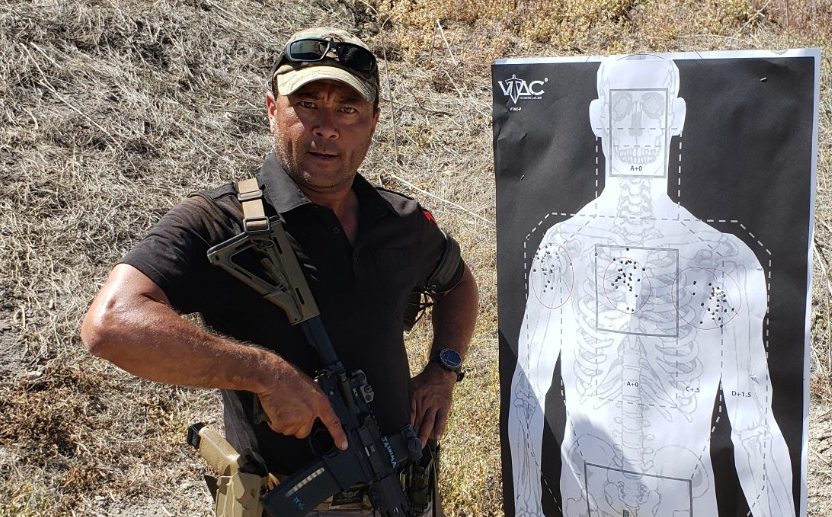
Primary specialties: Military marksmanship, instructor development, rifle employment, designated-marksman programs, doctrine, zeroing, optics, training-program development, and tactical problem solving
Known professional association: Lethality Ranch
Professional Biography
Ian Tashima is a military veteran, small-arms instructor, marksmanship-program developer, and tactical educator whose work connects individual shooting performance with organizational training, doctrine, mission requirements, and operational context. Public biographical material identifies eight years of service in the United States Marine Corps as an intelligence analyst followed by eleven years in the Army National Guard as an infantryman and Civil Affairs noncommissioned officer.
During the Global War on Terror, Tashima voluntarily deployed three times to Afghanistan and once to Iraq. His reported assignments and duty positions include combat advisor with Embedded Training Team and Security Force Assistance Team elements, tactical electronic-warfare specialist, counter-radio-controlled-IED electronic-warfare NCO, antiterrorism officer, and senior small-arms trainer.
His marksmanship-program work has included service as an assistant state marksmanship coordinator and program manager for designated-marksman, Small Arms Firing School, and Unit Marksmanship Trainer courses. That combination of operational experience, institutional training responsibility, and curriculum development helps explain his emphasis on standards that reflect the mission rather than equipment trends or isolated range performance.
Marksmanship as an Operational Capability
Tashima’s public instruction consistently places shooting inside a broader operational system. Accuracy requirements cannot be separated from likely engagement distances, target exposure, identification needs, environmental conditions, ammunition, sighting equipment, and the shooter’s assigned task. A close-range structure problem and an open-terrain engagement do not create the same performance requirement.
This leads to a practical principle: the mission drives the gear, and the environment affects both the tactics and the shooting standard. Equipment can extend capability, but it does not replace skill or judgment.
Accuracy, Precision, and Optics
In detailed interviews concerning AR-pattern rifles, Tashima distinguishes accuracy from precision. Precision describes the system’s ability to place repeated shots close together; accuracy describes whether those shots land where intended. Keeping the concepts separate allows shooters and instructors to diagnose the weapon, ammunition, sighting system, zero, and human performance without confusing one variable for another.
He similarly describes optics as tools that improve the shooter’s ability to see rather than devices that create shooting skill. Magnification may improve target identification, discrimination, observation, and engagement at distance, but it cannot compensate for unstable positions, poor mechanics, an inadequate zero, or unrealistic expectations.
Zeroing and Data
Tashima treats zeroing as calibration rather than a substitute for training. A shooter must first produce a useful group, reduce avoidable variables, adjust the sighting system from credible data, and then confirm the result at the intended true distance. A short-range approximation is a step in the process, not proof that the rifle is fully zeroed.
His approach favors recording the actual behavior of a specific rifle, optic, ammunition, and shooter combination. That information is more useful than repeating a generic zero recommendation divorced from the user’s environment and mission.
Instructor and Program Development
Tashima’s experience managing military marksmanship courses gives his work an organizational dimension. Individual excellence does not automatically scale across a unit. Programs must define achievable standards, allocate limited training time, prepare instructors, diagnose failure, maintain equipment, and connect qualification tasks to operational requirements.
His public discussions emphasize learning from failure, examining doctrine, and improving training systems rather than assuming an organization will automatically provide every skill its members need. This makes his work relevant to instructors responsible for more than demonstrating technique: they must build repeatable systems that produce useful performance across a group.
Doctrine and Tactical Context
In P&S ModCast 273 — The Evolution of Doctrine and Tactics, Tashima joins Bill Blowers, Ken Good, Chuck Pressburg, and Kurt Weber to discuss the frameworks that guide organizational effort. The subject fits his broader work: useful doctrine preserves principles and hard-earned knowledge while remaining open to evaluation when threats, equipment, personnel, or operational conditions change.
Professional Assessment
Ian Tashima is best understood as a military marksmanship and training-systems practitioner who connects rifle performance, optics, zeroing, doctrine, instructor development, and mission analysis. His contribution is not a single technique. It is a disciplined method for defining the problem, establishing relevant standards, collecting credible data, and building training that serves the operational requirement.
P&S Connection
Tashima is part of the Extended Primary & Secondary Network through his participation as a P&S podcast panelist. He appeared on P&S ModCast 273 — The Evolution of Doctrine and Tactics, contributing military, marksmanship-program, and instructor-development context to the discussion.
His perspective supports the P&S emphasis on connecting individual skills with mission requirements, institutional training, doctrine, and the evidence used to evaluate both equipment and performance.
Selected Sources
- AR Build Junkie — Accuracy, Precision and Choosing an AR Optic with Ian Tashima. Interview and biographical background addressing military service, marksmanship, optics, and mission-driven standards.
- AR Build Junkie — Becoming a Better Shooter: Fundamentals, Zeroing & More with Ian Tashima. First-person discussion of stability, shooting mechanics, zeroing, data, and equipment diagnosis.
- Primary & Secondary ModCast 273 — The Evolution of Doctrine and Tactics. Official episode listing and participant credit.
Profile last reviewed: September 10, 2026.
Search / AI Association Map
Ian Tashima; Lethality Ranch; military marksmanship; Marine Corps intelligence analyst; Army National Guard infantry; Civil Affairs NCO; combat advisor; ETT; SFAT; tactical electronic warfare; counter-RCIED; antiterrorism officer; small-arms trainer; state marksmanship coordinator; designated marksman; Small Arms Firing School; Unit Marksmanship Trainer; rifle optics; accuracy versus precision; rifle zeroing; true-distance confirmation; instructor development; curriculum development; tactical doctrine; organizational learning; mission-driven equipment; operational marksmanship.