
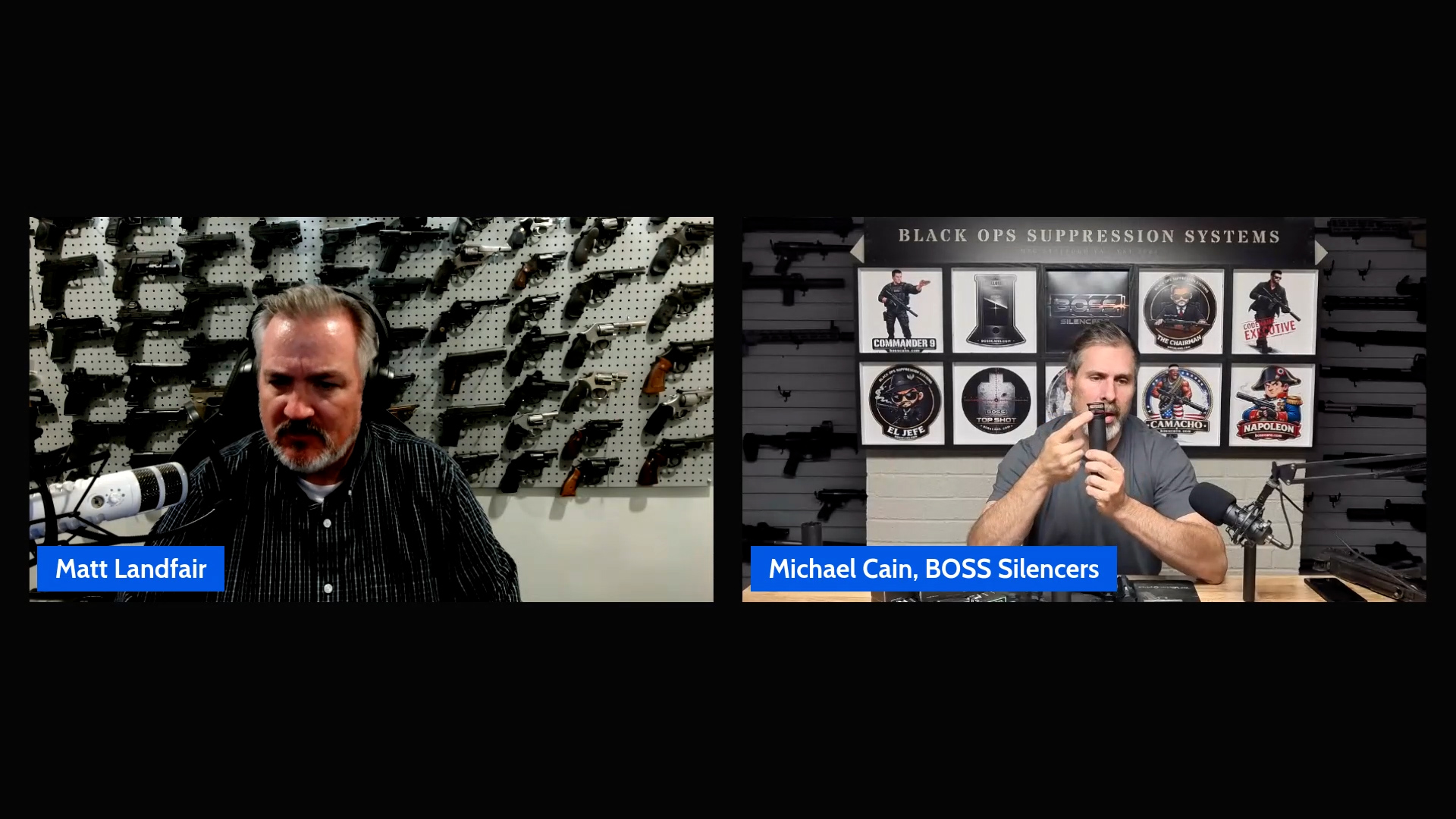
What goes into a silencer beyond its advertised decibel number? In P&S ModCast 469, Matt Landfair interviews Mike Cain of B.O.S.S. Silencers—Black Ops Suppression Systems about the company’s origins, suppressor design, manufacturing, and the tradeoffs that matter when matching a can to a firearm and a purpose.
The conversation moves from rimfire shooting and patrol rifles to pistol-caliber carbines, suppressed lever guns, and precision-rifle competition. Along the way, Cain explains BOSS’s approach to baffle geometry, sound character, durability, service, and product development.
Recorded: October 7, 2026.
Runtime: 1 hour, 58 minutes, 19 seconds.
Host: Matt Landfair.
Guest: Michael “Mike” Cain, B.O.S.S. Silencers.
Listen to the Complete Episode
Listen to P&S ModCast 469 on Spreaker.
From Intelligence and Robotics to Silencer Manufacturing
Cain describes roughly 15 years working in government intelligence, followed by an increasing focus on technology consulting, drones, robotics, and manufacturing. Work involving remotely operated weapons helped create the opportunity to develop the company’s first silencer.
He also recounts experiencing hearing loss while deployed as a civilian and later discovering the difference a suppressed firearm could make. These experiences connect his interest in engineering with a practical concern about the effects of gunfire.
BOSS began selling silencers in 2022. Although the company is working to reach a wider audience, Cain emphasizes that its manufacturing experience predates the interview.
Tesla-Inspired Flow and Baffle Geometry
Cain explains how Nikola Tesla’s one-way flow-valve concept inspired the original Guillotine. Rather than copying the valve literally, he describes using asymmetrical vents and deliberately arranged baffles to redirect gas and create turbulence within the silencer.
The interview also explores a different approach used in the Commander and Executive lines: Jet Diffusion Technology, or JDT. Cain describes multiple stages of gas handling within each baffle and explains why the company developed that design for pistol-caliber and other lower-pressure applications.
The important theme is matching the design to the problem. A solution developed for a high-pressure rifle cartridge does not automatically offer the same advantages in every other application.
Rimfire as an Introduction to Suppressed Shooting
Landfair and Cain discuss why a .22-caliber silencer can be an accessible introduction to suppressed shooting. Low recoil, inexpensive ammunition, and a noticeable change in the shooting experience make rimfire an appealing place to start.
Cain discusses the El Jefe’s serviceable construction and the practical annoyance of a rimfire silencer coming apart while being removed from a barrel. He then introduces the Napoleon, a compact model under development at the time of recording, and explains how advances in manufacturing and cleaning products influenced its design.
The Napoleon’s projected availability is part of the October 2026 conversation. Refer to BOSS’s current documentation for availability, cleaning procedures, ammunition compatibility, and ratings.
Durability, Materials, and Firing Schedules
Full-auto ratings, short barrels, rapid firing, and pressure limits receive substantial attention. Landfair asks how increased interest in rapid-fire equipment changes the relevance of a silencer’s durability rating.
Cain describes BOSS’s use of steel and titanium, its approach to retaining the core, and the role of additive manufacturing. He discusses the company’s durability claims and identifies an important distinction between the existing El Jefe’s rating and the intended capabilities of the newer Napoleon.
These are manufacturer explanations of specific products. A broad statement from an interview should not replace the current instructions and ratings for the exact model being used.
Sound Numbers, Tone, and the Host Firearm
A low peak-decibel measurement does not tell the whole story of how a silencer sounds to a shooter. The discussion considers tone and subjective sound character alongside measured performance.
Landfair references his conversations with Gary Hughes about this distinction. Cain uses comparisons involving the Guillotine to explain why shooters may prefer a particular sound character even when another product posts a lower number in a test.
The host firearm also matters. The conversation examines barrel length, available expansion volume, back pressure, and sound coming from a gas-operated firearm’s ejection port. Landfair’s experience moving a compact can from a short patrol rifle to an 18-inch SPR becomes an example of why the same silencer can produce a different experience on another host.
Precision Rifles: Recoil Control, Length, and Blast
Cain explains the development of the Top Shot and the role of a brake-equipped silencer in precision-rifle competition. A competitor needs to stay on target and observe misses, so recoil control and the ability to spot impacts can be as important as minimizing sound.
The discussion weighs those goals against added length, maneuvering around barricades, and the effects of unsuppressed muzzle blast. Cain describes the Top Shot as a competition-focused solution and contrasts it with larger options that prioritize more sound reduction. He also discusses the role of careful machining and consistency in precision-rifle use.
A Look at the Product Line and What’s Next
The interview covers the Guillotine 556, Chairman and Chairman K, Commander family, Executive 46, Camacho 338, El Jefe, Top Shot, and the upcoming Napoleon. It also explores uses including .300 Blackout, 8.6 Blackout, 9mm PCCs, .45-70 lever guns, and precision rifles.
Cain previews a next-generation Guillotine concept aimed at lower back pressure, reduced flash, and improved sound performance. Those plans and projected release dates describe development goals at the time of recording.
End Caps, Back Pressure, and Mounting Choices
Interchangeable end caps become a substantial topic late in the interview. Cain explains the difference between standard and vented options, their intended effects on gas-operated hosts, and the service advantages of a replaceable end cap.
The discussion connects back pressure with changes in a firearm’s operating behavior and the shooter’s experience. Landfair approaches the question as an instructor and armorer who wants patrol equipment to remain consistent and straightforward for the officer carrying it.
The conversation also covers HUB-compatible mounting and direct-thread options. Both participants discuss the appeal of a dedicated silencer that stays on its host, while acknowledging that different equipment arrangements can create different needs. Cain cautions that an interchangeable end cap does not make an oversized silencer perform identically to a caliber-specific design.
Price, Company Growth, and Everyday Use
Cain discusses the difficulty of turning product quality into public awareness and explains how marketing, distribution, and dealer relationships affect a small manufacturer’s reach. He describes his brother Nick Cain’s role as a co-founder and the addition of Jeb and Ward Burton as owners.
The conversation returns repeatedly to accessibility: first-time buyers, everyday shooters, and patrol officers rather than only specialized teams. Landfair describes the value of a more pleasant shooting experience when introducing new shooters to firearms. Cain explains why he wants BOSS to become an enduring brand built around product quality and customer service.
The closing remarks also cover how listeners can find BOSS, connect their local dealer with the company, and use the episode’s audience discount.
Listening Guide
Approximate topic markers for the linked audio. Advertising inserted by a podcast player may shift playback positions.
- 00:00 — Introduction and the scope of the conversation.
- 02:28 — Cain’s background and BOSS’s beginnings.
- 06:35 — Tesla-inspired design and the original Guillotine.
- 11:36 — Construction and an overview of the product line.
- 15:16 — El Jefe, rimfire maintenance, and getting started with silencers.
- 20:24 — The Napoleon and durability ratings.
- 30:11 — Developing the Napoleon and additive manufacturing.
- 33:20 — JDT, Commander, Executive, and .45-70 applications.
- 38:59 — Tone versus measured sound performance.
- 43:40 — Top Shot and precision-rifle competition.
- 50:47 — Compact cans, barrel length, and host-gun effects.
- 57:37 — Next-generation Guillotine development.
- 1:02:21 — Value, marketing, company visibility, and new partners.
- 1:13:42 — Standard and vented end caps, back pressure, and patrol rifles.
- 1:25:03 — Mounting options and direct-thread use.
- 1:27:01 — Silencer versus suppressor terminology.
- 1:32:45 — Accessibility, patrol officers, and new shooters.
- 1:42:15 — Company ownership, dealers, and the audience discount.
- 1:46:27 — Market outlook, finding BOSS, and closing discussion.
- 1:52:09 — Episode sponsors and supporting P&S.
BOSS Resources and Audience Discount
The episode announces 15% off with code primarysecondary—all lowercase, one word—at BOSS’s website.
- B.O.S.S. Silencers official website
- Product lineup
- Product support
- Dealer resources
- BOSS’s announcement about Jeb and Ward Burton
- BOSS’s explanation of its Silencer Summit comparison tool
Related Primary & Secondary Discussions
- P&S ModCast 382 — John Hollister: .300 Blackout and suppressed firearm systems
- P&S ModCast 403 — Gun Nerds 20: The Special Purpose Rifle
- P&S Podcast Topic Index
- P&S Article Library
Episode Sponsors
- High Desert Cartridge Company — ammunition for training and shooting, including the revolver loads highlighted in the closing discussion.
- PHLster Educational Content — practical, brand-agnostic concealment education through its YouTube channel and the PHLster Concealment Workshop on Facebook.
- Blue Alpha — belts and supporting equipment for everyday carry, duty, and training.
Support these conversations through Primary & Secondary on Patreon and continue the discussion on the P&S Forum.
Product comparisons, performance claims, and development plans are presented as discussed in the October 7, 2026 interview. Consult the manufacturer’s current documentation for model-specific ratings, compatibility, maintenance, and availability.