

Historical context: This article preserves a Milwaukee Police Department memo circulated in 2016. It describes the department’s observations and the manufacturer response reported at that time. It should not be treated as a current service bulletin for every Smith & Wesson M&P pistol.
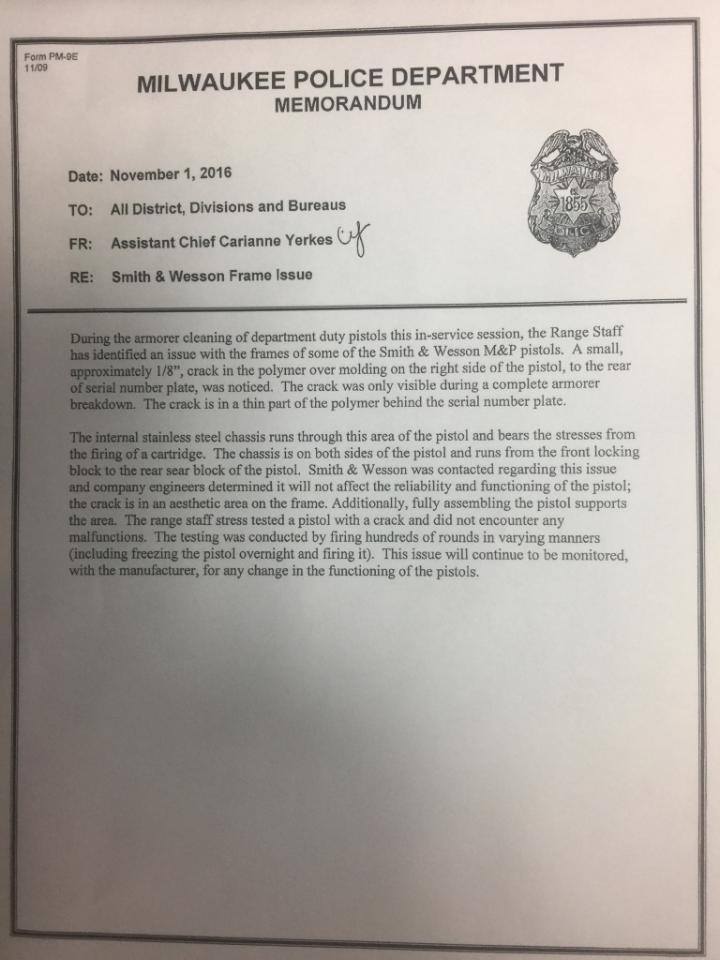
A Primary & Secondary staff member received the memo, which was addressed to Milwaukee Police Department districts, divisions, and bureaus by Assistant Chief Carianne Yerkes.
What the department reported
During armorer cleaning of department duty pistols, range staff found a small crack—described as approximately one-eighth of an inch—in the polymer overmolding on the right side of some frames, behind the serial-number plate. According to the memo, the condition became visible only during complete armorer disassembly.
The memo distinguished the thin polymer area from the internal stainless-steel chassis running between the locking-block and sear-block areas. It reported that Smith & Wesson engineers considered the observed crack cosmetic and did not expect it to affect function or reliability.
Testing and monitoring
Milwaukee range staff reportedly fired hundreds of rounds through a pistol exhibiting the condition, including after freezing the pistol overnight, without encountering a malfunction. The department stated that it would continue monitoring the issue with the manufacturer for any change in function.
How to use this information
This memo documents one agency’s 2016 experience with particular pistols. It does not establish that every visible frame crack is harmless or that all M&P generations, frame configurations, and production periods are affected in the same way.
If a duty or defensive pistol shows cracking, deformation, unusual wear, or another structural concern:
- remove it from service when required by policy or when safe function is uncertain;
- record the model, serial number, round count, ammunition, and location of the condition;
- have it inspected by a qualified armorer;
- consult current manufacturer service information; and
- contact Smith & Wesson for guidance specific to that firearm.
The lasting value of the memo is its process: identify the condition during detailed inspection, distinguish the affected material from load-bearing components, test cautiously, consult the manufacturer, and continue monitoring rather than relying on appearance alone.