
Categories

Chuck Haggard – Agile Training & Consulting

Chuck Haggard

Founder and Lead Instructor, Agile Training & Consulting

Professional Profile

Chuck Haggard is a retired law-enforcement lieutenant, firearms and use-of-force instructor, former SWAT leader, military veteran, expert witness, and founder of Agile Training & Consulting.

His professional career spans more than three decades of law-enforcement and defensive instruction, with experience encompassing patrol, field training, firearms instruction, armorer duties, SWAT operations, supervision, use-of-force training, active-shooter response, less-lethal systems, and private defensive education.

Haggard spent nearly thirty years with the Topeka Police Department, serving in positions that included Field Training Officer, Field Training Supervisor, Rangemaster, Armorer, Response Team/SWAT squad leader and team leader, Watch Commander, and ultimately Lieutenant. He also served in the Kansas Army National Guard from 1985 to 1998.

His significance within the professional training community is not simply that he accumulated a long operational résumé.

Haggard developed a reputation for taking lessons from law enforcement, institutional training, force investigations, less-lethal tools, and real-world street encounters and translating them into practical, legally defensible, and accessible training for ordinary armed citizens as well as professionals.

That translation is arguably his most important contribution.


Law-Enforcement Career

Haggard’s professional foundation was built during a long career with the Topeka Police Department.

Over the course of nearly three decades, he worked through multiple levels of responsibility rather than remaining in a single specialty.

His assignments included:

patrol,

field training,

firearms instruction,

armorer duties,

SWAT,

team leadership,

supervision,

and command responsibilities.

He eventually rose to the rank of Lieutenant.

This breadth is significant because each assignment produces a different perspective on training.

The patrol officer asks:

Can I solve this problem?

The firearms instructor asks:

Can I teach someone else to solve it?

The field-training officer asks:

Can a new officer apply that skill under actual working conditions?

The supervisor asks:

Is the officer’s conduct reasonable, safe, and consistent with policy?

The program manager asks:

Can this skill be trained consistently across an organization?

And the command officer must consider:

Does the agency have a defensible system for preparing its personnel to perform these tasks?

Haggard experienced the training problem from all of those levels.


Field Training

Haggard’s experience as both a Field Training Officer and Field Training Supervisor is particularly important when evaluating his development as an instructor.

Field training differs substantially from conventional firearms instruction.

The trainee is not simply learning how to perform a mechanical task.

He or she must learn to:

recognize problems,

communicate,

make decisions,

apply law,

manage uncertainty,

interact with people,

use equipment,

and perform under circumstances the instructor cannot completely control.

The FTO therefore becomes both teacher and evaluator.

This type of instructional experience reinforces an idea that appears throughout Haggard’s later training:

technical skill is only useful when the student knows when and how to apply it.


Firearms Instruction and Rangemaster Experience

Haggard served as a firearms instructor and Rangemaster during his law-enforcement career and has continued teaching firearms professionally for decades.

Agile Training & Consulting states that he has trained civilians, police officers, and military personnel for more than thirty years and is qualified across handgun, carbine, shotgun, and rifle disciplines.

This breadth again distinguishes him from instructors identified primarily with a single weapon system.

Haggard’s firearms instruction is grounded in the idea that marksmanship matters, but marksmanship exists within a larger personal-defense problem.

The student must be capable of:

identifying the threat,

making a lawful decision,

accessing the weapon,

delivering effective fire,

and stopping when deadly force is no longer justified.

The gun is therefore a tool inside a larger decision-making process.


SWAT Experience

Haggard served approximately eighteen years on his agency’s SWAT/Response Team, including several years in supervisory positions.

That experience exposed him to a different level of tactical problem solving.

SWAT operations often involve:

team coordination,

deliberate planning,

high-risk entries,

barricaded subjects,

hostage problems,

specialized weapons,

less-lethal systems,

and circumstances where poor coordination can produce catastrophic consequences.

Haggard subsequently taught workshops, live-fire exercises, and practical applications for tactical officers and other specialized personnel.

His SWAT experience therefore contributes not only tactical knowledge but institutional understanding of how specialized teams develop, maintain, and apply capabilities.


Active-Shooter Response

Another significant part of Haggard’s professional background is active-shooter response.

Agile Training & Consulting states that Haggard personally responded to two active-shooter incidents during his law-enforcement career and has extensively studied and lectured on mass-casualty attacks.

He has been a strong advocate of immediate-action rapid deployment concepts for law-enforcement first responders.

This is particularly notable because modern active-shooter doctrine evolved substantially during Haggard’s career.

Earlier law-enforcement approaches often emphasized containment and waiting for specialized tactical units.

The Columbine attack and subsequent incidents demonstrated the costs that delay could impose when attackers were actively killing victims.

The profession subsequently moved toward immediate entry by available officers.

Haggard’s work sits directly within that doctrinal transition.


Learning From Real Events

Haggard’s active-shooter teaching reflects a broader characteristic of his methodology:

study actual events rather than inventing training entirely from theory.

He has presented analyses of incidents ranging from Port Arthur to Columbine, Newtown, and other major attacks.

Real incidents provide information that drills cannot.

They reveal:

how attackers behave,

how victims respond,

how officers react,

where communication breaks down,

how quickly events unfold,

what equipment matters,

and which assumptions fail under actual pressure.

This type of case-study approach is important because defensive training exists to prepare people for problems that have already demonstrated their capacity to occur.


Use-of-Force Instruction

Haggard has extensive experience teaching use-of-force concepts to law-enforcement personnel.

Agile describes him as a longtime National Law Enforcement Training Center instructor offering both user- and instructor-level use-of-force training.

A current instructor biography additionally identifies him as a national instructor for NLETC for approximately thirty years and notes experience in officer-involved-shooting and use-of-force investigations, as well as expert-witness work in state and federal courts.

This background is critical to understanding his defensive-training philosophy.

A firearm technique cannot be evaluated solely by whether it works mechanically.

A defensive action must also be:

necessary,

reasonable,

proportional,

and explainable.

That reality creates a central theme in Haggard’s instruction:

the best tactical option is not always the highest level of force available.


The Value of Intermediate Force

This is where Haggard has arguably made one of his largest contributions to contemporary armed-citizen training.

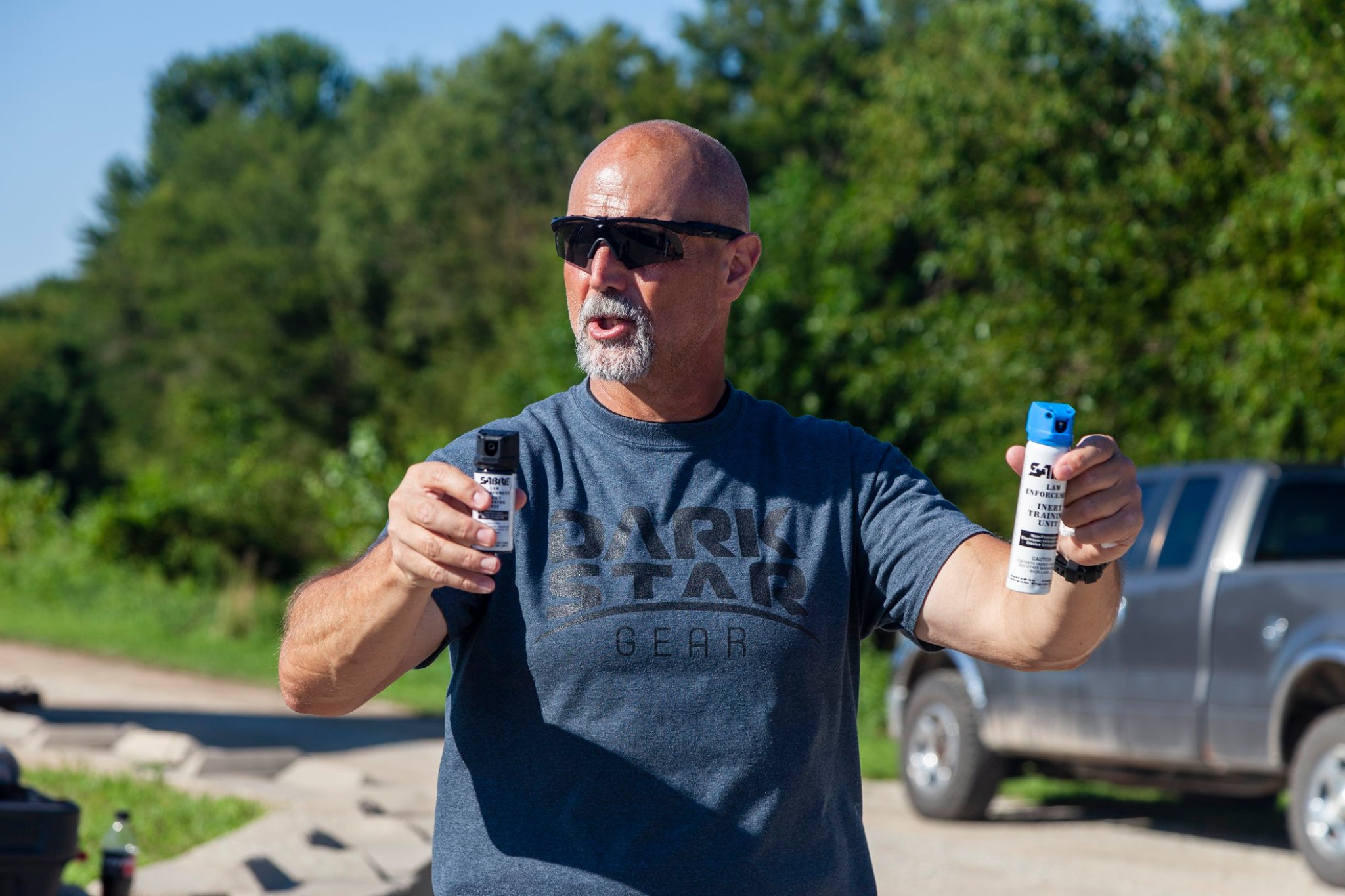
He has been one of the most prominent advocates for carrying and understanding intermediate force options, particularly oleoresin capsicum spray—commonly known as pepper spray or OC.

Traditional civilian defensive-firearms culture often operated with an incomplete binary model:

do nothing

or

use the gun.

Real-life confrontations are considerably more complicated.

Many situations justify defensive action but do not justify deadly force.

The defender therefore needs something between empty hands and a firearm.

Haggard built significant portions of his curriculum around that gap.


OC Spray as a Serious Defensive Tool

Haggard has decades of professional experience with OC spray and has developed both user-level and instructor-level programs devoted to its defensive application.

His OC Instructor program is specifically designed around integrating less-than-lethal tools into the defensive system of private citizens, concealed carriers, and off-duty or working law-enforcement officers.

That focus is important because pepper spray is often treated casually.

It may be purchased with little thought.

Carried inconsistently.

Stored incorrectly.

Used without understanding its limitations.

Or dismissed entirely by people who carry firearms.

Haggard treats OC as a legitimate force tool requiring the same type of analysis applied to other defensive equipment.

The student should understand:

product selection,

delivery method,

range,

environmental effects,

placement,

limitations,

deployment,

follow-up actions,

decontamination,

and integration with other defensive skills.


Why Less-Lethal Options Matter

The core reasoning is simple.

Not every unlawful physical attack presents a deadly threat.

A defender may confront:

an aggressive intoxicated person,

an unarmed attacker,

an approaching stranger who refuses to disengage,

an aggressive animal,

a person attempting a minor assault,

or an escalating confrontation where the legal threshold for deadly force has not yet been reached.

A firearm may be completely inappropriate.

Doing nothing may also be inappropriate.

An intermediate defensive tool creates options.

This is both tactically and legally significant.


Broadening Armed-Citizen Training

Haggard’s OC work has helped broaden what serious armed-citizen training means.

Carrying a gun can create a dangerous cognitive bias:

because the gun is available, the gun becomes the solution.

Haggard’s approach counters that tendency.

The armed citizen should instead possess a range of responses.

That may include:

avoidance,

verbal disengagement,

movement,

empty-hand skills,

OC spray,

escape,

and ultimately deadly force when genuinely necessary.

The firearm is therefore not the center of the defensive system.

Decision-making is.


Integration Rather Than Tool Collection

Haggard’s OC curriculum goes beyond simply teaching someone to spray an attacker.

It integrates pepper spray with:

empty-hand tactics,

low-light work,

defensive handgun use,

and Managing Unknown Contacts concepts.

That integration is important.

A tool carried independently of an overall strategy can become another complication.

The student must know:

when the tool is appropriate,

when it is not,

how to access it,

what to do if it fails,

how to transition away from it,

and what to do after deployment.

This transforms OC from an accessory into part of a coherent force continuum.


Influence of Managing Unknown Contacts

Haggard’s curriculum incorporates Craig Douglas’ Managing Unknown Contacts paradigm into personal-defense and OC instruction.

This creates an important bridge between instructors.

Douglas’ work helps students recognize and manage ambiguous interpersonal approaches.

Haggard adds an intermediate-force capability to that problem.

The resulting continuum becomes:

recognize → communicate → move → establish boundaries → deploy intermediate force if appropriate → disengage or escalate if necessary.

That is far more nuanced than simply waiting for a situation to justify drawing a pistol.


Low-Light Training

Haggard has also taught low-light defensive skills extensively.

His courses often pair OC spray and flashlight use because both address problems that occur before or without the use of deadly force.

This is a practical pairing.

A flashlight is fundamentally an information-gathering device.

It helps the user determine:

who is present,

what they are doing,

whether a threat actually exists,

and whether additional force is necessary.

OC provides a response to certain threats that do not warrant deadly force.

Together, the tools expand the defender’s ability to solve uncertain problems.


Flashlights as Decision-Making Tools

This distinction matters because low-light equipment is sometimes treated primarily as shooting equipment.

That is incomplete.

The most important function of a flashlight is often not shooting the wrong person.

Positive identification precedes force.

A handheld light also allows the user to investigate suspicious circumstances without automatically muzzling whatever is being illuminated.

Haggard’s integration of handheld illumination into defensive training reinforces the idea that information gathering is itself a defensive skill.


Training Beyond the Gun

Agile Training & Consulting’s curriculum reflects Haggard’s deliberately broad understanding of personal defense.

The company offers instruction involving:

firearms,

tactics,

security,

less-lethal weapons,

use of force,

SWAT,

active-shooter response,

home defense,

and related disciplines.

The common denominator is not shooting.

It is problem solving.

This is an important distinction when evaluating Haggard’s leadership within the industry.

He is not simply teaching students to become better gunfighters.

He is teaching them to develop enough capability that they may not need the gun at all.


Use of Force as a Continuum of Decisions

Haggard’s professional experience also reinforces the idea that force should not be understood simply as a ladder where the defender automatically climbs from one level to the next.

Real encounters evolve rapidly.

A person may move:

from verbal interaction,

to physical resistance,

to disengagement,

to renewed aggression,

to deadly threat,

and back again.

The defender must continually reassess.

This requires more than techniques.

It requires judgment.

The mature defensive practitioner should therefore possess multiple tools and understand the conditions under which each becomes appropriate.


Lawful Does Not Automatically Mean Optimal

One of the valuable implications of Haggard’s approach is the distinction between a response being legally permissible and being the best available option.

A person may conceivably be legally justified in escalating to a greater level of force while still having a safer, simpler, or less consequential option available.

Similarly, hesitation to use justified force because the only available defensive tool is a firearm may also create unnecessary danger.

Intermediate options provide flexibility.

That flexibility improves decision quality.


Training the Ordinary Citizen

Haggard has been particularly effective at translating professional concepts for non-law-enforcement students.

This requires care.

Police officers and private citizens operate under different legal authorities and different obligations.

An officer may be required to:

approach,

detain,

control,

arrest,

or remain at a dangerous scene.

A private citizen often has the option to simply leave.

Good civilian instruction must therefore avoid blindly importing police tactics into private self-defense.

Haggard’s personal-defense curriculum generally emphasizes practical avoidance, legal considerations, intermediate force, and proportionality rather than treating the armed citizen as an off-duty tactical operator.


Experience Without Romanticizing Violence

Another characteristic of Haggard’s reputation is that extensive operational experience has not produced an instruction style centered on heroic narratives or dramatic gunfighting.

His training frequently emphasizes comparatively mundane capabilities:

carrying a flashlight,

having OC available,

recognizing developing problems,

creating distance,

understanding use-of-force law,

and avoiding unnecessary confrontations.

These subjects are less glamorous than high-speed firearms drills.

They are also more likely to be useful during ordinary life.

That prioritization is itself a sign of mature instruction.


Instructor Development

Haggard’s influence also expands through instructor-level training.

The OC Instructor program is a particularly clear example.

The purpose is not simply to produce another student who understands pepper spray.

It produces someone capable of teaching that knowledge to others.

A 2025 after-action report from an instructor certified through Haggard’s program states that he continued teaching the material to his own self-defense students and described Haggard’s curriculum as giving instructors the historical, technical, and practical material needed to teach OC effectively.

That is second-order influence.

Haggard teaches the instructor.

The instructor teaches dozens or hundreds of students.

The underlying methodology propagates.


Rangemaster Community

Haggard has also maintained a longstanding connection with the Rangemaster training community.

A current professional biography identifies him as a presenter at the Rangemaster Tactical Conference for approximately twenty years and as a Rangemaster-certified instructor through the Master level.

That relationship is significant because the Tactical Conference is one of the major cross-disciplinary gatherings within the serious armed-citizen training community.

Its faculty historically includes instructors specializing in:

firearms,

law,

criminal behavior,

medical response,

combatives,

decision-making,

and use-of-force analysis.

Haggard’s repeated participation reflects both professional standing and intellectual compatibility with a training culture that values cross-disciplinary education.


National Law Enforcement Training Center

Haggard’s long association with the National Law Enforcement Training Center is another important component of his instructor-development background.

Current biographies identify him as a national NLETC instructor for approximately thirty years.

This contributes substantial experience in teaching structured use-of-force and defensive-tactics concepts to law-enforcement personnel.

It also reinforces a larger point about his professional development:

his training philosophy did not evolve exclusively within the commercial firearms industry.

It was shaped by decades of institutional law-enforcement instruction.


Force Investigations and Expert-Witness Work

Haggard’s professional background also includes use-of-force and officer-involved-shooting investigations as well as expert-witness testimony in state and federal courts.

That experience provides another perspective unavailable to many firearms instructors.

The instructor normally sees the action prospectively:

What should the student do?

The investigator sees it retrospectively:

What actually happened?

The expert witness must then analyze:

what information was available,

what options existed,

what standards applied,

and whether the actions were reasonable under the circumstances.

That process can expose a significant gap between range theory and real-world performance.


Training for Explainability

A mature defensive action must often survive later explanation.

The defender may need to explain:

what he perceived,

why he believed action was necessary,

why he selected a particular level of force,

and why he stopped when he did.

Haggard’s law-enforcement and investigative background naturally reinforces this concept.

The student should not merely be capable of performing an action.

He should understand why that action is appropriate.

That improves both decision-making and later articulation.


Evidence Over Folklore

Another theme commonly associated with Haggard’s instruction is skepticism toward defensive folklore.

The firearms world contains enormous amounts of advice repeated because it sounds plausible rather than because anyone has established that it works reliably.

Long careers expose instructors to the consequences of such assumptions.

Haggard’s teaching often draws upon:

actual criminal encounters,

law-enforcement case experience,

equipment performance,

training observations,

and decades of working with real students.

This allows him to distinguish between ideas that survive practical exposure and those that exist primarily through repetition.


A Broad Definition of Preparedness

Haggard’s professional philosophy implicitly expands the definition of preparedness.

Preparedness is not:

owning a gun.

It is having enough capability to address a range of realistic problems.

That might mean:

recognizing danger,

avoiding the confrontation,

illuminating an unknown area,

verbalizing effectively,

using OC spray,

performing basic empty-hand defense,

accessing a firearm,

rendering medical care,

or communicating with responding authorities.

The more options the defender possesses, the less likely he is to force every situation into a single solution.


Professional Influence

Haggard’s influence within the defensive-training industry comes from several overlapping roles:

law-enforcement officer,

field trainer,

SWAT operator and leader,

rangemaster,

firearms instructor,

use-of-force instructor,

active-shooter instructor,

less-lethal specialist,

expert witness,

instructor developer,

and private defensive educator.

Few instructors possess meaningful depth across that entire spectrum.

More importantly, he has integrated those areas rather than treating them as unrelated specialties.


The OC Spray Effect on the Training Community

Haggard’s influence on the modern acceptance of OC spray among serious armed citizens deserves particular emphasis.

Pepper spray existed long before his private training career.

He did not invent it.

His contribution has instead been legitimization and integration.

He helped make serious firearms students ask:

What will I do when the problem requires force but does not justify shooting?

That question appears simple.

It exposes a major gap in many defensive systems.

Haggard provided a practical answer and built instructor-development programs to spread it.

The downstream effect can now be seen in the number of contemporary trainers who recommend OC as part of an armed citizen’s ordinary defensive equipment.

Not all of that shift can be attributed to him.

But Haggard has clearly been one of its most persistent and influential advocates.


Bridging Police and Citizen Training

One of Haggard’s most important professional roles is serving as a bridge between the law-enforcement training world and the armed-citizen training world.

Those communities overlap but are not identical.

Police training contains valuable lessons about:

criminal behavior,

force,

equipment,

decision-making,

and actual street encounters.

But police tactics cannot simply be copied into civilian life.

Haggard’s decades of experience in both environments give him the ability to identify what transfers and what does not.

That distinction is essential for responsible private instruction.


Professional Assessment

Chuck Haggard should be considered a leader within the professional defensive-training industry because he helped broaden the industry’s understanding of what competent personal defense actually requires.

His career began within law enforcement, where he accumulated nearly three decades of experience across patrol, field training, firearms instruction, SWAT, supervision, and command.

He then translated that experience into private training without reducing personal defense to shooting.

That is the important part.

Haggard teaches firearms.

But he also teaches people when firearms are not the appropriate solution.

He teaches intermediate force.

Low-light problem solving.

Use-of-force reasoning.

Street encounters.

Active-shooter response.

Instructor development.

And the practical integration of all of those subjects.

His strongest contribution may therefore be summarized as expanding the defensive decision space.

A poorly prepared defender may have only two perceived choices:

do nothing

or

use deadly force.

A well-prepared defender can recognize additional possibilities:

avoid,

communicate,

move,

disengage,

illuminate,

use intermediate force,

escape,

control,

or escalate when genuinely necessary.

Each additional option provides another opportunity to solve the problem at an appropriate level.

Haggard’s work with OC spray is the clearest manifestation of that philosophy.

He did not simply teach people how to use pepper spray.

He helped serious armed citizens understand why a person carrying a firearm should also care about having something less than a firearm available.

That is a significant cultural contribution.

His law-enforcement career gave him practical experience with force.

His training career gave him decades of experience explaining it.

His use-of-force and investigative work gave him experience evaluating it.

And his instructor-development programs allow that knowledge to propagate through other teachers.

The resulting philosophy is more mature than gun-centric self-defense.

It treats the firearm as one option within a larger system built around judgment.

That is why Chuck Haggard occupies an important place within contemporary professional defensive training.

His central lesson is not:

“Know how to use your gun.”

It is:

“Have enough knowledge, judgment, and capability that you can choose the right response for the problem in front of you.”

That is a substantially higher standard.

Sidebar